SPICE is now accepting applications for the 2019 East Asia Summer Institute for High School Teachers. This free three-day institute is SPICE’s premier professional development opportunity for teachers, combining Stanford’s deep content expertise with SPICE’s award-winning lesson plans.
SPICE/NCTA East Asia Summer Institute for High School Teachers July 8–10, 2019 Stanford University Application deadline: May 6, 2019
High school teachers of social studies and language arts are especially encouraged to apply.
Participants will learn from Stanford faculty and other experts about the geography, cultures, politics, economics, history, and literature of East Asia, including a special focus on U.S.–Asia relations and the Asian diaspora in the United States. Teachers will also engage in pedagogy-focused discussions and receive training on several SPICE lesson plans on East Asia, in order to help them translate their new content knowledge to the classroom. Teachers who complete the professional development seminar will be eligible for a $250 stipend and three units of credit from Stanford Continuing Studies, and they will leave Stanford with several extensive SPICE curriculum units in hand.
This professional development opportunity will focus largely on China, Japan, and Korea. For example, last year’s speakers included Kathleen Stephens (former U.S. Ambassador to the Republic of Korea), Peter Duus (renowned Stanford scholar of modern Japan), and Clayton Dube (Director of the USC U.S.-China Institute). The institute also featured speakers like author Chun Yu (who grew up in China’s Cultural Revolution) and Joseph Yasutake (who grew up in a Japanese American internment camp), whose rich personal stories brought history to life. SPICE staff led complementary interactive curriculum training sessions on China’s economic development, the atomic bombing of Hiroshima, South Korean pop culture, and East Asia’s “history wars.”
“Every speaker added a new perspective to historical and contemporary events,” remarked participant Kimberly Gavin. “[The] lectures enriched my knowledge base of topics, curriculum demonstrations gave me ideas for effective lessons in the classroom, small group discussions led to rich conversations about primary and secondary sources, and teacher sharing introduced me to new websites. There wasn’t anything that was done that wasn’t valuable to me… I told my administrator yesterday that this was the best conference I have been to as a teacher.”
Please note: Due to unexpected funding reductions this year, we are only able to offer our high school institute in 2019. We hope to bring back our middle school institute next year.
As a high school student in San Jose in the late 1960s and early 1970s, I used to see Norman Mineta on occasion in San Jose’s Japantown. Once at Fukuda Barber in Japantown, Mineta was on the barber chair. After he left, barbers Takeo and Atsuo Fukuda asked me if I knew who he was. I didn’t, and Takeo told me that he was Norman Mineta, vice mayor of San Jose. Since that day, I recognized Mineta whenever I saw him in Japantown, in the San Jose Mercury News, and on television. In 1971, Mineta became mayor of San Jose, and in 1974, he ran successfully for the U.S. House of Representatives. He was reelected ten more times. Mineta also served as President Bill Clinton’s Secretary of Commerce from July 2000 to January 2001 and President George W. Bush’s Secretary of Transportation from January 2001 to August 2006. Never did I imagine that our paths would cross professionally through my work at SPICE. From 2017, SPICE curriculum designer Rylan Sekiguchi assumed the responsibility of authoring lesson plans for a project called “What Does It Mean to Be an American?”—a free web-based curriculum toolkit inspired by Mineta’s life and career.
As a 10-year-old Japanese American boy in 1942, Norman Mineta was powerless when his country imprisoned him and his family in a fit of wartime hysteria. But nearly 60 years later, he sat at the highest levels of government as the United States reeled from 9/11 and began experiencing a new hysteria. In times of crisis like these, how has the institution of civil liberties been affected by individuals like Mineta whose voices guide government policy, and how have those changes impacted the lives of Americans? This was the central question that Mineta and Sekiguchi focused their comments on during their National Council of History Education session, “Civil Liberties in Times of Crisis,” on March 16, 2019.
"Civil Liberties in Times of Crisis" session at the 2019 NCHE conference, led by Rylan Sekiguchi and Secretary Norman Mineta.
The 30 teachers in attendance were first offered a preview by Sekiguchi of the soon-to-be released “What Does It Mean to Be an American?” The lesson plans, explained Sekiguchi, consist of six independent learning modules that examine a key theme from Secretary Norman Mineta’s life and career: immigration, civil liberties and equity, civic engagement, justice and reconciliation, leadership, and U.S.–Japan relations. The lessons were developed in consultation with Mineta and the Mineta Legacy Project team, including Dianne Fukami and Debra Nakatomi, who were also in attendance. Fukami and Nakatomi are the producers of the documentary film, Norman Mineta and His Legacy: An American Story.
Following the curriculum preview, Mineta reflected upon his life and highlighted the striking parallels between the hysteria following the Japanese attack on Pearl Harbor on December 7, 1941 and the hysteria following 9/11. His memories of the immediate aftermath of Pearl Harbor seemed to be seared in the back of his mind as he spoke, as he vividly recalled seeing his father cry for the first time and wondering where his neighbor of Japanese descent had suddenly been taken, and by whom. (He later learned it was the FBI.) A short time later, Mineta and his family were also evicted from their home in San Jose, California and incarcerated in Heart Mountain, Wyoming, as part of what is often called the mass internment of Japanese Americans.
Mineta also shared his memories of the morning of 9/11—being informed as Secretary of Transportation of the first plane hitting the twin towers, watching the live broadcast as the second plane hit, and then being called to the Presidential Emergency Operations Center, a bunker-like underground structure that lies below the White House. He recalled how he had asked one of his chiefs to draw up the new flight security guidelines that would govern aviation henceforth, and the first bullet point was “No racial profiling will be used.” He also vividly recalled how President George W. Bush, in the aftermath of 9/11, firmly declared that the United States would not let what happened to Norm and his family (following the Pearl Harbor attack) happen again. “You could’ve knocked me off my chair with a feather!” Mineta reflected.
Deborah Rowland with Secretary Norman Mineta
Following the session, comments from teachers underscored the success of the session. “A number of participants said they’d never seen anything like our lessons before. One teacher told us that even though she expected our session would be her conference highlight, she was still overwhelmed!” reflected Sekiguchi. “That was so heartening to hear. I hope everyone in our session felt that way. Even more than that, I hope they feel inspired to educate the next generation about the importance of civil liberties and share these lessons from Secretary Mineta’s life.” Deborah Rowland was among the teachers who attended the conference. She tweeted, “Such a privilege to visit with this incredible man today. Norman Mineta, former Secretary of Transportation, former Secretary of Commerce, former Congressman, former childhood detainee of Executive Order 9066, always an American.”
The documentary film Norman Mineta and His Legacy: An American Story will receive a national PBS airing on May 20. Fukami and Nakatomi hope that the film and lesson plans become widely used in U.S. schools and carry on the legacy of Norman Mineta. They noted, “They are important tools to help young students grapple with the divisiveness in U.S. society today and to underscore the critical importance of considering civil liberties-related issues in U.S. history as well as today.”
I had the privilege of attending several screenings of the film. At the San Jose screening, it was gratifying to listen to tributes to Mineta from people who represent San Jose’s diverse communities, and it was especially moving to witness them and numerous Japanese Americans in attendance give a standing ovation to Mineta following the screening. An old family friend in attendance used to also frequent Fukuda Barber and we boasted about how our barber used to also cut the hair of Norman Mineta.
Hero Image
Secretary Norman Mineta with Debra Nakatomi (left) and Dianne Fukami (right) and Rylan Sekiguchi
Professor Justin Gest will present an unique study of immigration governance across 30 countries in Europe, North America, Latin America, East Asia, Oceania, and the Middle East. Relying on a database of immigration demographics in the world’s most important immigrant destinations, he will present a taxonomy and an analysis of what drives different approaches to immigration policy over space and time. In an era defined by inequality, populism, and fears of international terrorism, he will show how governments are converging toward a “Market Model” that seeks immigrants for short-term labor with fewer outlets to citizenship— an approach that resembles the increasingly contingent nature of labor markets worldwide.
Image
Justin Gest is an Assistant Professor of Public Policy at George Mason University’s Schar School of Policy and Government. He studies immigration and the politics of demographic change. He is the author of four books: Apart: Alienated and Engaged Muslims in the West (Oxford University Press/Hurst 2010); The New Minority: White Working Class Politics in an Age of Immigration and Inequality (Oxford University Press 2016); The White Working Class: What Everyone Needs to Know (Oxford University Press 2018); and Crossroads: Comparative Immigration Regimes in a World of Demographic Change (Cambridge University Press 2018). He has authored peer-reviewed articles in journals including Comparative Political Studies, Ethnic and Racial Studies, and the International Migration Review. He has also provided reporting or commentary for BBC, CNN, The Guardian, Los Angeles Times, NPR, The New York Times, Politico, Reuters, Vox, and The Washington Post. Professor Gest received the 2014 Joseph R. Levenson Memorial Teaching Prize, Harvard’s highest award for faculty teaching. In 2013, he received the 2013 Star Family Prize for Student Advising, Harvard’s highest award for student advising. In 2007, he co-founded the Migration Studies Unit at the London School of Economics (LSE).
On January 18, 2019, Stanford Global Studies and the Stanford Program on International and Cross-Cultural Education (SPICE) hosted a book talk by Professor Michael McFaul. McFaul served for five years in the Obama administration, first as Special Assistant to the President and Senior Director for Russian and Eurasian Affairs at the National Security Council (2009–2012), and then as U.S. Ambassador to the Russian Federation (2012–2014). He is also one of several contributing scholars to Inside the Kremlin, SPICE’s lesson plan on Soviet and Russian history. McFaul’s talk was given to approximately 30 community college and secondary school educators from the San Francisco Bay Area. Three of the educators—Nancy Willet, Phillip Tran, Don Uy-Barreta—are 2018–19 Stanford Education Partnership for Internationalizing Curriculum (EPIC) Fellows, and this article highlights their reflections.
Ambassador McFaul has described From Cold War to Hot Peace as “three books in one.” First, it is a book that explains the arc of U.S.–Russia relations since the end of the Cold War. Second, it a book that describes the “reset” in U.S.–Russia relations and its aftermath during the Obama presidency. Third, it is a book about McFaul’s life that describes how his involvement with the debate team at Bozeman High School, Montana, sparked his interest in Russia and led to his subsequent study of Russia at Stanford University, Oxford University, and in Russia itself. During his talk, he touched upon all three.
McFaul’s reflections not only provided the educators with important content on U.S.–Russia relations and insights from his youth to his ambassadorship, but also prompted the educators to consider effective teaching and pedagogical strategies. McFaul’s use of storytelling, presentation of multiple perspectives, emphasis on interdisciplinarity, and sharing of first-hand accounts gave the educators a glimpse into McFaul not only as an academic and diplomat but as a teacher.
EPIC Fellow Nancy Willet, Co-chair of the Business & Information Systems Department, College of Marin, noted, “I was most impressed with Ambassador McFaul’s engaging storytelling. His first-hand insights of his time spent studying and working in Russia challenged some of my misguided assumptions and helped expand my understanding of the complexities of U.S.–Russia relations. I grew up during the Cold War and the Ambassador disrupted some of my deep-rooted misconceptions about the former Soviet Union and further opened my mind for a more nuanced understanding.” In a follow-up communication, Willet said that she is devouring From Cold War to Hot Peace and plans to share McFaul’s scholarly insights with her law students—particularly when discussing democracy and rule of law—here and abroad.
EPIC Fellow Philip Tran, Instructor of Business, San Jose City College, remarked that “Ambassador McFaul’s talk reinforced the complicated notion of human relations and the importance of an interdisciplinary study of it—including political science, business, economics, etc. Interdisciplinarity is a key to grasping a better understanding of human relations.” He continued by noting that the biggest take-away from McFaul’s talk was that it cautioned him as a teacher to “refrain from the natural ‘knee-jerk’ reactions and to seek a deeper understanding of the situation from all sides…. Even though Ambassador McFaul is a subject matter expert on U.S.–Russian relations, he displayed humility and acceptance of ambiguity in his responses to some of the toughest questions regarding the U.S. relationship with Russia and Vladimir Putin.”
EPIC Fellow Don Uy-Barreta, Instructor of Economics, De Anza College, reflected upon the significance of sharing first-hand experiences with students. He noted that “Reading about Ambassador McFaul’s experience is very informative, but being able to ask questions and hearing it from the source is a whole different level of experience. As he was telling us about his days in Russia, it felt like I was right next to him, and it gave me goosebumps.” Uy-Barreta found inspiration in McFaul’s talk as he prepares for his presentation on global economics at the EPIC Symposium on May 18, 2019 during which the 2018–19 EPIC Fellows will present their research at Stanford.
McFaul has given numerous talks on From Cold War to Hot Peace but this was the first geared to an audience of educators. As I observed his talk, I was primarily attentive to the pedagogical strategies that he utilized to engage the educators. For me, his effective teaching made the history and insights in From Cold War to Hot Peace come alive and feel more like “four books in one.”
This book talk was made possible by a U.S. Department of Education Title VI grant that provides professional development opportunities for K–12 teachers and community college instructors. Among these opportunities is EPIC, a program that provides one-year fellowships to community college instructors. Title VI grant collaborators include Stanford Global Studies (SGS), SPICE, Lacuna Stories, andthe Stanford Graduate School of Education’s Center to Support Excellence in Teaching. SGS’s Denise Geraci and SPICE’s Jonas Edman organized and facilitated the talk by Ambassador McFaul.
Holger Nehring is Professor of Contemporary European History at the University of Stirling in Scotland, where he also directs the research program on human security, conflict and co-operation. He did his DPhil at Oxford University as a Rhodes Scholar on the history of peace movements in the Cold War and then worked at Oxford and Sheffield Universities before taking up the position at Stirling. While at Stanford, he is working on a new project on NATO infrastructure and the Cold War in Europe as well as on issues related to the history of nuclear-weapons proliferation.
To listen to the audio recording of this talk, please visit our multimedia page.
While Ephesos was inscribed in the UNESCO world heritage list in 2015, Vienna is in danger of losing the title because of building projects in the city center. From these two rather different examples, the whole UNESCO process including application, inscription, and monitoring will be critically reviewed and the question of accuracy, independency, and scrutiny of UNESCO and related organizations raised. National exertions of influence will be reflected upon, as they often contradict expert evaluations. In conclusion, the issue ought to be addressed whether something like “World Cultural Heritage,” in the sense of global responsibility, actually exists, and whether the national administration of the world heritage sites in fact excludes this aspiration. Ultimately the overriding question is raised as to how a consciousness for cultural heritage, apart from touristic-economic incentives and beyond national (in many cases regional) borders, can be created.
Image
Sabine Ladstätter studied Classical Archaeology, Prehistory, Protohistory and Ancient History at the Universities of Graz and Vienna, culminating in a Master's degree (University of Graz) in 1992 and a Doctoral degree at the University of Vienna in 1997. Between 1997-2007 she held the position of Research Assistant at the Institute for the Cultural History of Antiquity at the Austrian Academy of Sciences. After her Habilitation at the University of Vienna in 2007 she moved to the Austrian Institute of Archaeology, the directorship of which she assumed in 2009. At the same time, the directorship of the excavations at Ephesos was assigned to her. Awards for Scientist of the Year in 2011 in Austria, and for the best popular scientific book in Austria in 2014, are proof of her engagement in the areas of scientific communication and public outreach. She is a member of the German Archaeological Institute and of the Archaeological Institute of America, as well as numerous national and international scientific and editorial boards, and is a referee for leading research promotion institutions. Visiting professorships at the Ecole Normale Superieur de Paris (2016) and Stanford University (2019) underscore her engagement in the fields of education and teaching, also attested by her supervision of academic degrees at a variety of European universities.
On November 1-2, 2018, the two-day conference "Future Visions: Opportunities and Challenges of Korean Studies in North America" was convened by Shorenstein APARC's Korea Program to examine the current state of Korean studies and consider the current challenges and opportunities. This report summarizes the discussions of the six panels on history, literature, the social sciences, language education, library collections and services, and the Korean Wave.
Under the title “Political Contestation and New Social Forces in the Middle East and North Africa,” the Program on Arab Reform and Democracy convened its 2018 annual conference on April 27 and 28 at Stanford University. Bringing together a diverse group of scholars from across several disciplines, the conference examined how dynamics of governance and modes of political participation have evolved in recent years in light of the resurgence of authoritarian trends throughout the region.
Image
Delivering the opening remarks of the conference, Freeman Spogli Institute (FSI) and Hoover Institution Senior Fellow Larry Diamond reflected on the state of struggle for political change in the Middle East and North Africa (MENA) region. In a panel titled “Youth, Culture, and Expressions of Resistance,” FSI Scholar Ayca Alemdaroglu discussed strategies the Turkish state has pursued to preempt and contain dissent among youth. Adel Iskandar, Assistant Professor of Communications at Simon Fraser University, explained the various ways through which Egyptian youth employ social media to express political dissent. Yasemin Ipek, Assistant Professor of Global Affairs at George Mason University, unpacked the phenomenon of “entrepreneurial activism” among Lebanese youth and discussed its role in cross-sectarian mobilization.
The conference’s second panel, tilted “Situating Gender in the Law and the Economy,” featured Texas Christian University Historian Hanan Hammad, who assessed the achievements of the movement to fight gender-based violence in Egypt. Focusing on Gulf Cooperation Council states, Alessandra Gonzales, a Visiting Postdoctoral Fellow at the Stanford Institute for Economic Policy Research, analyzed the differences in female executive hiring practices across local and foreign firms. Stanford University Political Scientist and FSI Senior Fellow Lisa Blaydes presented findings from her research on women’s attitudes toward Female Genital Mutilation (FGM) in Egypt.
Image
Speaking on a panel titled “Social Movements and Visions for Change,” Free University of Berlin Scholar Dina El-Sharnouby discussed the 2011 revolutionary movement in Egypt and the visions for social change it espouses in the contemporary moment. Oklahoma City University Political Scientist Mohamed Daadaoui analyzed the Moroccan regime’s strategies of control following the Arab Uprisings and their impact on various opposition actors. Nora Doaiji, a PhD Student in History at Harvard University, shared findings from her research examining the challenges confronting the women’s movement in Saudi Arabia.
The fourth panel of the conference, “The Economy, the State, and New Social Actors,” featured George Washington University Associate Professor of Geography Mona Atia, who presented on territorial restructuring and the politics governing poverty in Morocco. Amr Adly, an Assistant Professor of Political Science at the American University in Cairo, analyzed the relationship between the state and big business in Egypt after the 2013 military coup. Rice University Professor of Economics Mahmoud El-Gamal shared findings from his research on the economic determinants of democratization and de-democratization trends in Egypt during the past decade.
Image
The final panel focused on the international and regional dimensions of the struggle for political change in the Arab world, and featured Hicham Alaoui, a Research Fellow at Harvard University’s Weatherhead Center for International Affairs, Georgetown University Political Scientist Daniel Brumberg, and Nancy Okail, the Executive Director of the Tahrir Institute for Middle East Policy.
The conference included a special session featuring former fellows of the American Middle Eastern Network at Stanford (AMENDS), an organization dedicated to promoting understanding around the Middle East, and supporting young leaders working to ignite concrete social and economic development in the region. AMENDS affiliates from five different MENA countries shared with the Stanford community their experiences in working toward social change in their respective countries.
Hero Image
ARD 2018 Annual Conference participants.
Front row (from left): Hanan Hammad, Hamza Arsbi, Ayca Alemdaroglu, Mahdi Lafram, Lior Lapid.
Second to front row (from left): Dina El-Sharnouby, Daniel Brumberg, Radidja Nemar, Mona Atia.
Third to front row (from left): Hesham Sallam, Joel Beinin, Nora Doaiji, Hicham Alaoui, Mohamed Daadaoui, Salma Takky, Larry Diamond, Amr Adly, Sultan Al Amer, Heba Al-Hayek.
Back row (from left): Amr Gharbeia, Mahmoud El-Gamal, Amr Hamzawy
Future Visions: Challenges and Possibilities of Korean Studies in North America — Social Science panel. From left to right: UC Berkeley's Laura Nelson, University of Michigan's Jordan Siegel, Stanford's Yong Suk Lee, USC's David Kang, Harvard's Paul Chang.
How can Korean studies faculty cultivate supportive and critical scholarly communities with graduate students? What can be done to overcome the severe constraints on Korean language training in North America? Why is there a dearth of Korea scholarship in academic literature? And how should Korean studies librarians prepare for the future in the light of new technologies and young researchers’ increasing interest in digital scholarship?
These were some of the questions examined at a two-day conference, “Future Visions: Challenges and Possibilities of Korean Studies in North America,” convened by the Korea Program of Stanford’s Shorenstein Asia-Pacific Research Center (APARC) on November 1-2. Co-sponsored by the Seoul-based Foundation Academia Platonica, the conference, the first of its kind, gathered distinguished Korean studies scholars from twelve North American institutions to consider the state of the field, assess its challenges, and carry forward a vision for its future direction and potential. Its six unique panels focused not only on the major disciplines of Korean studies—history, literature, and the social sciences—but also on language education, library collections and services, and Korean Wave.
“The presentations and discussions by our fellow experts reflected the breadth and depth of Korean studies in North America,” says APARC Director and the Korea Program Director Gi-Wook Shin. “Our program was established at Stanford in 2001 and has since become a leader in Korean studies in North America, so it is a special privilege for us to bring together colleagues from eminent institutions around the continent to further advance Korean studies education and research in the academic and policy worlds, and to build upon our track record of action and achievements.”
“The field of Korean studies, however,” notes Shin, “has significantly changed over the past seventeen years and it isn’t without its challenges. This is our opportunity to consider frankly where we go next and how we could explore the path ahead together.”
Conference participants indeed engaged in deep conversations and shared ideas and dilemmas regarding teaching in the different disciplines of Korean studies in North America. Harvard sociologist Paul Chang listed three types of challenges facing the field: publication, academic, and professional challenges. David C. Kang, professor of international relations and director of the Korean Studies Institute at the University of Southern California, emphasized the publication challenge: why is it, asked Kang, that top academic journals in the discipline of political science and international relations publish so much more scholarship about Europe than they do about Korea and Asia at large, even while the rise of Asian nations is surely one of the most consequential issues of the twenty-first century? The onus, Kang argued, comes back to East Asia scholars “to produce better and more compelling scholarship, and to better train graduate students.”
University of British Columbia's Ross King and conference participants.
Yet complex issues surround the question of how to broaden graduate coursework—and whether to do so. Korean language and linguistics expert Ross King, head of the department of Asian Studies at the University of British Columbia in Vancouver, Canada, was one of several panelists who considered the obstacles to graduate training, among different aspects of academic challenges facing the field of Korean studies. King probed into how Sinocentrism and what he called the “Mandarin conceit”—that is, the notion that training in Literary Sinitic should be predicated on a near-native proficiency in modern Mandarin Chinese—are emerging as a major stumbling block to the study of premodern Korean literary culture. He also pointed to the constraints on language training in both Korean and hanmun in North America, which, he claimed, is why we can probably anticipate continued decrease in the number of ethnically non-Korean (non-Korea-educated) graduate students undertaking graduate study in Korean literature.
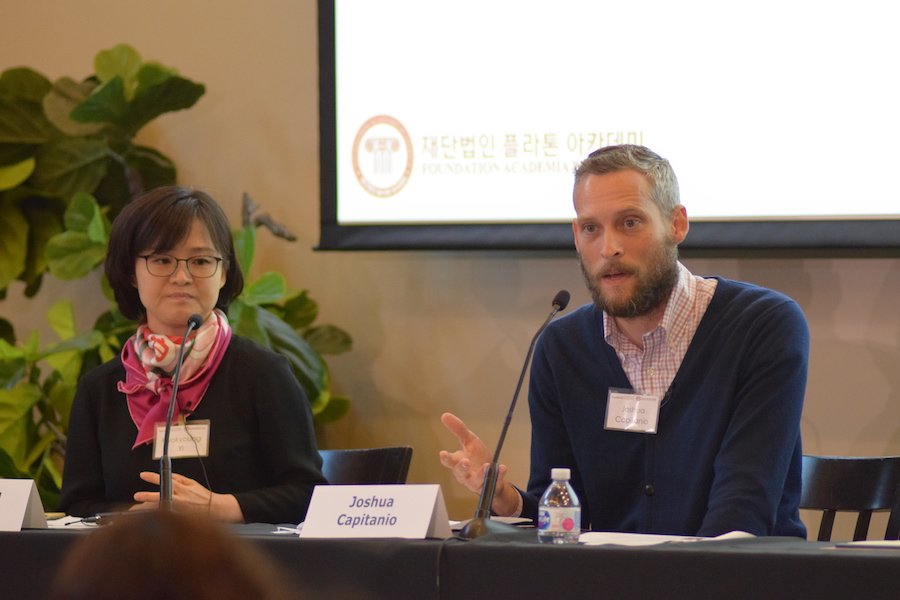
University of Washington's Hyokyoung Yi (left) and Stanford's Joshua Capitanio at a panel on library collections and service.
Sung-Ock Sohn, who coordinates the Korean language program in the department of Asian languages and cultures at the University of California – Los Angeles, further shed light on King’s prediction. She explained that while enrollments in Korean language classes have shown a sharp increase in American higher education institutions in the past decade, particularly at the introductory level and among ethnically non-Korean students, there is a high attrition rate of students from an introductory to advanced Korean classes nationwide.
How should the field move forward?
Participants proposed a host of ideas to that end. These included helping graduate students collaborate with colleagues in Korea; dedicating funding for junior faculty to spend periods of time before tenure conducting research and honing language skills in Korea at appropriate institutions, and for mid-career scholars to spend a year in Korea; emphasizing the application of social science theories and methods to premodern and modern East Asia; motivating scholars to apply a comparative lens to the study of the historical and contemporary experience of East Asia; and integrating linguistic and cultural diversity in Korean language classes by, for example, incorporating service learning in authentic contexts and extending the content spectrum to include topics such as Korean popular culture.
Image
K-pop star Siwon Choi (left) highlights closing panel on Korean Wave.
Korean Wave was the focus of the conference’s widely attended closing panel that featured K-pop star Siwon Choi, a member of Korean boy band Super Junior, and multi-platinum music producer Dominique Rodriguez, managing director of SM Entertainment USA. They spoke about the global reach of Korean pop music and some of the ways in which Korean popular culture could stimulate interest in Korean studies. Dafna Zur, assistant professor in Stanford’s department of East Asian languages and cultures, who chaired the panel, challenged her students to consider “what it means not just to monetize culture but to design culture with specific markets and audience in mind.” The Stanford Daily published a detailed article on the panel.
“We are grateful to Foundation Academia Platonica for its generous support of Stanford’s Korea Program at Shorenstein APARC and for making this conference possible through our shared vision for the future of Korean studies in North America,” said Gi-Wook Shin. “Our thanks also go to our many other friends and partners, including the Korea Foundation that has helped achieve great results through its commitment to promoting understanding of Korea in academia and beyond and its support of the overseas Korean Studies Program since its establishment in 1991.”
South Korean TV company SBS NBC filmed the conference that will be featured in an upcoming documentary about Korean studies in the United States.
Read the conference report or listen to the audio recordings of the sessions, below.


 "Civil Liberties in Times of Crisis" session at the 2019 NCHE conference, led by Rylan Sekiguchi and Secretary Norman Mineta.
 Deborah Rowland with Secretary Norman Mineta