Past pandemics redistributed income between the rich and poor, according to Stanford historian
Throughout recorded history, pandemics have been effective levelers of social and economic inequality – but that might not be the outcome this time around, says Stanford historian Walter Scheidel.
APARC is pleased to announce that two young scholars, Jeffrey Weng and Nhu Truong, have been selected as our 2020-21 Shorenstein postdoctoral fellows on contemporary Asia. They will begin their appointments at Stanford in autumn 2020.
The Shorenstein Postdoctoral Fellowship on Contemporary Asia is open to recent doctoral graduates dedicated to research and writing on contemporary Asia, primarily in the areas of political, economic, or social change in the Asia-Pacific, or international relations in the region.
Fellows develop their dissertations and other projects for publication, present their research, and participate in the intellectual life of APARC and Stanford at large. Our postdoctoral fellows often continue their careers at top universities and research organizations around the world and remain involved with research and publication activities at APARC.
Meet our new postdoctoral scholars:
Image
Jeffrey Weng Shorenstein Postdoctoral Fellow on Contemporary Asia
Research focus: How does society shape language, and how does language shape society?
Jeffrey Weng is completing his Ph.D. in sociology at the University of California, Berkeley. He holds a BA in political science from Yale University, and his work has appeared in the Journal of Asian Studies and Theory and Society. His research focuses on the evolution of language, ethnicity, and nationalism in China.
Jeffrey's dissertation examines language in the context of Chinese nation-building. Mandarin Chinese was artificially created about a century ago and initially had few speakers. Now, it is the world’s most-spoken language. How did this transition happen? Weng's research shows how the codification of Mandarin was done with the intention to match existing practices closely, but not exactly. Top-down efforts by the state to spread the new language faced enormous difficulties, and ultimately its wide-spread adoption may have been catalyzed more by economic growth and urban migration. By investigating how these monumental social and political changes occurred, Weng’s work deepens the understanding of societal shifts, past and present, in one of the world’s predominant nations, while also contributing more broadly to scholarship on class, the educational reproduction of privilege, and the construction and reconstruction of race, ethnicity, and nation.
At Shorenstein APARC, Weng will continue to publish papers based on his doctoral research while reworking his dissertation into a book manuscript.
Image
Nhu Truong Shorenstein Postdoctoral Fellow on Contemporary Asia
Research focus: Why are some authoritarian regimes more responsive than others?
Nhu Truong is a Ph.D. candidate in comparative politics in the Department of Political Science at McGill University, with an area focus on China, Vietnam, and Southeast Asia. She received an MPA in International Policy and Management from the Wagner Graduate School of Public Service at New York University, an MA in Asian Studies from the University of Texas at Austin, and a BA in International Studies from Kenyon College. Prior to embarking on her doctoral study, she worked in international development in Vietnam and Cambodia, and with policy research on China.
Her research focuses on authoritarian politics and the nature of communist and post-communist regimes, particularly as it pertains to regime repressive-responsiveness, the dynamics of social resistance, repertoires of social contention, and political legitimation.
Nhu Truong’s dissertation explains how and why the communist, authoritarian regimes of China and Vietnam differ in their responsiveness to mounting unrest caused by government land seizures. Drawing on theory and empirical findings from 16 months of fieldwork and in-depth comparative historical analysis of China and Vietnam, Truong uses these two regimes as case studies to explore the nature of responsiveness to social pressures under communist and authoritarian rule and the divergent institutional pathways that responsiveness can take. She posits that authoritarian regimes manage social unrest by relying on raw coercive power and by demonstrating responsiveness to social demands. But not all authoritarian regimes are equally responsive to social pressures. Despite their many similarities, the Vietnamese communist regime has exhibited greater institutionalized responsiveness, whereas China has been relatively more reactive.
As a Shorenstein Fellow, Truong will develop her dissertation into a book manuscript. She plans to continue exploring the variable outcomes and knock-on effects of authoritarian responsiveness in places like Cambodia, which will further support her comparative research on China and Vietnam and lay the groundwork for her next project.
Encina Hall
616 Jane Stanford Way
Stanford, CA 94305
0
jaqueline.bemmer@univie.ac.at
Visiting Postdoctoral Scholar at The Europe Center, 2019-2020
jaqueline_bemmer_headshot_4x5.jpg
Jaqueline Bemmer is a postdoctoral researcher and lecturer at the Law Faculty of the University of Vienna and a Visiting Postdoctoral Scholar at The Europe Center. She is a Celticist, historian and legal scholar, specializing in early medieval Irish law as well as late Roman law. She earned her DPhil in History from the University of Oxford producing the first thesis on the law of pledging in early medieval Ireland, focused around the legal tract Bretha im Ḟuillemu Gell (Judgements on Pledge Interests).
Her current monograph: ‘Poena: conceptions of pain and suffering in late Roman legal sources’ deals with a critical period of transition and multi-normativity in European legal history situated at the threshold between the fading Roman Empire in the West and the rise of Christendom and small Germanic kingdoms in early medieval Europe, examining normative approaches to punishment, criminal procedure and penal policies. She is hosted by Prof. Walter Scheidel.
Jaqueline Bemmer has taught Irish, Welsh and Roman law as well as Latin legal terminology. She is a member of The Royal Historical Society and the Irish Legal History Society, and was a Visiting Scholar at the Centre for Scots Law, University of Aberdeen. She is articles editor for the Journal of the European Society for Comparative Legal History and has most recently been selected for participation in the Wallace Johnson Program at The Medieval Institute at Western Michigan University.
This event is co-sponsored with The Abbasi Program in Islamic Studies.
ABSTRACT
Organized groups with cross class networks and institutional links to different social constituencies have often been behind revolutionary mobilizations. The Egyptian case in 2011 conveys a different dynamic. Small youth groups played leading roles in organizing and strategizing for the mass protests attracting large numbers of participants? How was that possible? And why were middle-class employees, the white-collar and professional sectors, overrepresented in the mobilizations? Finally, how could we understand the rise of these movements at this juncture. I argue that the Egyptian mass protests could be understood by adopting a middle ground approach between organization and spontaneity. There are cases when prior militancy, demands for union democracy, and political links with the democracy movement prepared middle-class employees to join in larger numbers. In other cases, participation was spontaneous resulting from growing grievances against the state. I also show that political realignments in the early 2000s created openings that led to both a rise in labor unrest and invigorated the democracy movement - eventually culminating in the 2011 mass mobilizations.
SPEAKER BIO
Image
Nada Matta is an assistant professor in the Departments of Global Studies and Modern Languages and Sociology at Drexel University. Her research interests are in political economy, social movements and gender studies; and she primarily investigate questions of structural inequality and social change in the Middle East. Nada is the co-author of “the Second Intifada: A dual Strategy Arena” published in the European Journal of Sociology, and is writing a book about the Egyptian Revolution of 2011.
This event is co-sponsored with The Abbasi Program in Islamic Studies.
ABSTRACT
Benazir Bhutto in Pakistan, Roza Otunbayva in Kyrgystan, Megawati Sukarno Putri in Indonesia: female Muslim leaders are seen as pioneers at the forefront of the empowerment of women in Muslim-majority countries and more generally the empowerment of women on a global scale. The younger generation of women Muslim leaders have forged their political struggle and discourse in the post-9/11 context. More recently, they have surfed the wave of hope and disillusion of the Spring revolution(s). A major difference with the first generation of female Muslim leaders is that the younger generation’s political identity is strongly grounded in Islamic references. They are (or have labelled themselves) as Islamists, Islamist democrats or Muslim democrats that propose an alternative to the exclusive secular discourse.
Through the experience of Sayida Ounissi, we explore the genuine and challenging role of a new generation of female leaders, in Muslim democrats or Islamist parties. This discussion goes beyond the common assumptions and clichés of the veil oppressed Muslim women, the question of the compatibility between Islam and democracy or Islam and feminism. It rather looks at the rise of young women Muslim democrats in Islamist or Muslim parties in a way to grasp the feminine, and sometimes feminist, re-definition of the Islamic tradition and Islamist or Muslim democrats discourse. It explores the modes of transmission of political struggle and ideologies, from fathers to daughters, and from mothers, whether passive or active Islamists, to daughters. Finally, it examines the challenges posed to their ascensions within their parties and society by analysing how these women are re-appropriating conservative Islamic codes, other cultural or religious practices, and the social and political concepts inherent to their respective local and global context, in order to secure legitimate ascension in their parties and societies.
SPEAKRER BIO
Image
Sayida Ounissi is a member of the Tunisian Assembly of People’s Representatives and Minister for Employment and Vocational Training. She represents Tunisians living in the North of France for the Ennahdha Party and was first elected in October 2014 and reelected in October 2019. In 1993, her family fled the dictatorship of Ben-Ali for France where she completed all of her schooling. In 2005, she joined the University of Paris 1 Panthéon Sorbonne for a double degree in History and Political Science. She obtained her Masters at the Institute for the Study of Economic and Social Development, and completed her studies with an internship at the African Development Bank in Tunis. In 2016, she was recruited by Prime Minister Youssef Chahed to join his Cabinet as Secretary of State in the Ministry of Employment and Vocational Training, charged with vocational training and private initiative. In 2018, she was promoted as the Minister for Employment and Vocational Training, becoming the youngest minister in Tunisia.
MODERATOR BIO
Image
Sophie Lemiere is a Political Anthropologist and FSI-Humanities Center International Visitor, 2019-20, at Stanford University. She is a former Fellow for the Democracy in Hard Places Initiative at the Ash Center for Democracy, Harvard University. In 2014, she received her PhD from Sciences-Po, France. Her thesis was the first study on the political role of gangs through umbrella NGOs in Malaysia. In 2019-2020, Sophie has been awarded the Visiting Fellowship at the Center for Southeast Asian Studies at Kyoto University and the Reagan-Fascell Democracy Fellowship at the International Forum for Democratic Studies (National Endowment for Democracy-NED), in Washington, D.C.
Encina Commons Room 123 Encina Commons 615 Crothers Way Stanford, CA
After a long period of under-appreciation, Michel Serres's prescient and unique writing is now beginning to receive the attention it has long deserved. This talk explores the distinctiveness and contemporaneity of Serres’s thought, paying particular attention to the "figures" that distinguish not only the themes he addresses, but also the way he approaches and passes between them. What emerges is a picture of a body of work radically distinct from that of his contemporaries Derrida, Deleuze and Foucault, and a set of concerns the timeliness of which is only now becoming evident.
Dr. Christopher Watkin is a Senior Lecturer at Monash University, Melbourne, Australia, where he teaches across French and Literary Studies. He is the author of a number of books in modern and contemporary thought, including Phenomenology or Deconstruction? (2009), Difficult Atheism (2011), and French Philosophy Today: New Figures of the Human (2016). His latest monograph, Michel Serres: Figures of Thought, is due to be published with Edinburgh University Press in early 2020. Chris is currently working on a project interrogating the concepts of freedom and liberation in contemporary thought and society in the light of what has been called the Western “emancipation narrative”. He blogs about philosophy and academic research at christopherwatkin.com, and you can find him on Twitter @DrChrisWatkin.
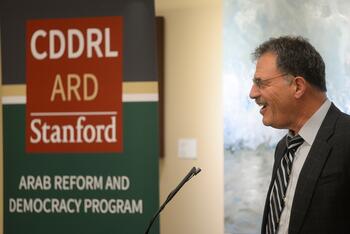
CDDRL’s Program on Arab Reform and Democracy held its annual conference at Stanford University on October 11 and 12, titled “The Struggle for Political Change in the Arab World.” The conference is an outgrowth of ARD’s efforts to support new research on the dynamics of political change in the countries of the Arab world. Scholars from across different disciplines sought to understand how social, economic, and political dynamics at the national level, as well as international and regional conflict and power rivalries, impact struggles for political and social change in the region.
Overview of Panels and Speakers
Image
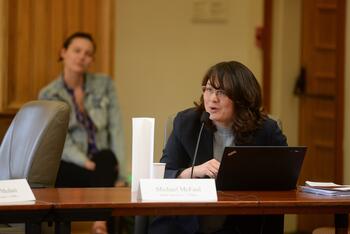
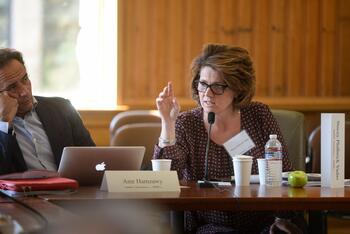
Following opening remarks by FSI Senior Fellow Larry Diamond, the first panel titled “The Boundaries of Authoritarianism post-Arab Uprisings” featured CDDRL Senior Research Scholar Amr Hamzawy. His paper examined how the regime of Abdel Fattah Al-Sisi has employed discursive strategies to discredit calls for democratic change in the country. Sean Yom, Associate Professor of Political Science at Temple University, outlined how the protest strategies of Jordanian youth have limited their effectiveness in advancing meaningful political change. University of California, Davis Scholar Samia Errazzouki discussed the failure of state-led political and economic reform in Morocco.
Chaired by Harvard University Fellow Hicham Alaoui, the second panel was titled “Popular Uprisings and Uncertain Transitions.” University of California, Santa Cruz Political Scientist Thomas Serres provided an overview of the economic disruptions that contributed to Algeria’s uprising. Lindsay Benstead, who is an Associate Professor of Political Science at Portland State University, analyzed the electoral successes of Tunisia’s Ennahda Party. Khalid Medani, Professor of Political Science at McGill University, explained how Sudanese protesters leveraged new strategies of contention to force Omar Al-Bashir out of power.
Farah Al-Nakib (right) and Michael Herb (left)
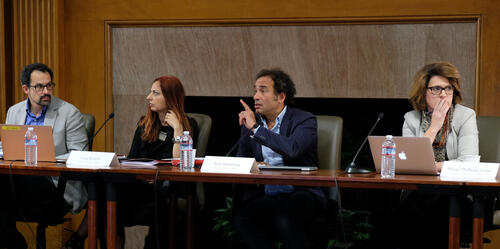
The third panel, titled “Politics, Succession and Sectarianism in the GCC States,” included Oxford University Fellow Toby Matthiesen, who discussed how Saudi Arabia and the GCC states have increasingly sought to protect their regimes by actively molding the politics of their autocratic patrons in the region, and by using new technologies to upgrade the effectiveness of their surveillance states. Georgia State University Political Scientist Michael Herb explained how the aging of the Saudi line of succession contributed to the political ascendancy of Crown Prince Mohammad Bin Salman and the decay of family rule in the country. Cal Poly Historian Farah Al-Nakib described how Kuwait’s royal family has used its sponsorship of large-scale development projects to sidestep the country’s political polarization, undermine the power of the parliament, and weaken public access to spaces of political contestation.
Image
The fourth panel focused on “Social Strife and Proxy Conflict in the Middle East.” Chatham House Scholar Lina Khatib described Syria’s transformation during the civil war from a highly centralized security state to a transactional state in which the regime depends heavily on local powerbrokers. Stacey Philbrick Yadav, Associate Professor and Chair of the Department of Political Science at Hobart and William Smith Colleges, discussed differences in how local communities in Yemen have been affected by the country’s conflict. David Patel, who serves as Associate Director for Research at the Crown Center for Middle East Studies at Brandeis University, argued that Iraq’s democratic institutions have been impressively robust to a series of existential challenges, but he also highlighted a widespread feeling among the Iraqi public that its parliamentary system is failing to deliver.
Image
Finally, the fifth panel examined the topic of “International Forces in the Arab Political Arena.” Stanford University Political Scientist Lisa Blaydes suggested that China’s efforts to involve itself in the regional economy may improve its reputation among economically-frustrated Arab citizens, but that such efforts also spell trouble for democracy and human rights in the Middle East. Hamid & Christina Moghadam Director of Iranian Studies at Stanford University Abbas Milani argued that Iran’s ideological commitment to exporting the Islamic Revolution has been remarkably consistent for several decades. Colin Kahl, Co-director of the Center for International Security and Cooperation at FSI, reviewed the strategies of US administrations toward the Middle East, and posited that President Trump’s approach of pursuing maximalist objectives with minimal commitments is particularly likely to heighten instability in the region. FSI Scholar Ayca Alemdaroglu emphasized that Turkey’s neo-Ottoman foreign policy has failed to achieve its objectives in the face of mounting regional upheaval.
Common Themes of Political Change and Continuity
Image
Several themes emerged from conference presentations. First, across the panels, scholars discussed the lessons learned by autocrats and activists alike in the aftermath of the Arab Spring, and the ways in which these lessons have transformed regional politics. Hamzawy emphasized that the Sisi regime in Egypt has increasingly relied on intensive repression over cooptation to maintain stability, while at the same time refusing to grant even limited political openings as existed under Hosni Mubarak’s presidency. In part, this change appears to be rooted in the regime’s belief that relaxing the state’s authoritarian posture had contributed to the revolutionary upheaval of 2011. Likewise, Matthiesen suggested that Saudi Arabia and the Gulf Cooperation Council States have learned to become more aggressive in strengthening their surveillance apparatus and policing popular discourse transnationally. By contrast, Serres discussed how the Algerian military and bureaucracy have responded to mass protests not by intensifying repression, but instead by attempting to coopt anti-corruption initiatives and democratic reforms to limit political and economic change. Similarly, regarding Kuwait, Al-Nakib illustrated how the restructuring of urban spaces has proved itself a subtle but successful strategy for the royal family to rehabilitate its reputation while limiting geographic focal points for popular politics.
Image
Activists have also learned their own lessons from the aftermath of the Arab Spring. According to Yom, Jordanian activists continue to look to the leaderless revolutions of Tunisia and Egypt as a model to be emulated. As a result, they prioritize agility and horizontality in their protests, and they forgo the organization of formal political movements. This approach has succeeded in acquiring short-term concessions from the regime but has failed to generate broader structural changes. On the other hand, activists in Sudan appear to have been more successful at using lessons from the Arab Spring to push for systematic transformations of their political system. According to Medani, Sudanese protesters developed novel tactics to avoid the repression of the coercive apparatus, and they were effective at gradually forging a counterhegemonic discourse that clearly exposed the regime’s failures to the public. Following the overthrow of Omar Al-Bashir, activists in Sudan have also insisted on dismantling the political and economic might of the deep state to avoid following Egypt’s path.
Image
Second, the conference discussion indicated widespread dissatisfaction with formal political institutions across the region. For instance, Hamzawy suggested that Sisi’s regime has been relatively successful at discrediting civilian political institutions, including the legislature and civilian-led ministries. Errazzouki highlighted widespread dissatisfaction in Morocco with existing political institutions. Likewise, Yom’s discussion of activists in Jordan emphasized their lack of interest in entering formal politics. In Kuwait, the royal court has found an opening to pursue urban development projects outside of normal institutions in part because of the public’s frustration with gridlock in the legislature. Patel speculated that frustration with the parliament and muhasasa system in Iraq may finally prompt major changes to the country’s political process.
Image
Third, despite this disillusionment with formal politics, these political institutions have proved remarkably durable in countries across the region. For example, though current frustrations may finally prompt change in Iraq, Patel also highlighted the resilience of the parliamentary system in the face of a sectarian civil war, US troop withdrawal, the rise of ISIS, and a number of other major challenges. For both Algeria and Sudan, Serres and Medani stressed that militaries continue to exercise significant influence despite the popular uprisings. Meanwhile, for Egypt, Hamzawy noted the firm grip of the current military regime on power, and for Morocco, Errazzouki described the lack of systematic changes to the country’s ruling monarchy, even after years of popular pressure.
Image
Fourth, this durability has not precluded a number of important shifts within existing political institutions. Regarding Syria, for instance, Khatib explained how the survival of Bashar al-Asad’s presidency has depended on moving state institutions away from a centralized security state to a transactional state reliant on local actors with a degree of independence from the regime. Herb described how the consensus-based family rule of the Saudi monarchy fell victim to deaths among the aging senior princes, which opened up opportunities for the king to appoint more officials in a manner that heightened his direct influence. Herb suggested that Mohammad Bin Salman recognized this change and knew that he would likely lose relevance upon his father’s death; as a result, he was motivated to gamble on consolidating his control while his father still held the power to issue royal decrees. In Algeria, the influence of the military and bureaucracy may remain paramount for now, but Serres also pointed out that protesters have succeeded in stripping away the civilian intermediaries who used to protect these institutions. Regarding the durability of local institutions, Yadav noted how pre-conflict and even pre-unification institutions in Yemen have continued to operate effectively in a number of local communities around the country.
Image
Fifth, foreign interventions will continue to destabilize the region and impede prospects for democratization or post-conflict reconstructions in the coming years. Khatib noted that Russia has positioned itself as the agenda setter who can bring the Syrian state back to its feet, but also that Russia and Iran are competing to profit off the country’s reconstruction. For Yemen, Yadav argued that fragmentation at the local level has important implications for best practices in the international community’s reconstruction efforts, but that current actors are not well positioned to understand these trends. Kahl predicted that the Middle East strategy of the Trump administration would likely contribute to further destabilization of the region because of its emphasis on empowering allies to do what they want and go after Iran while the United States maintains its distance. Meanwhile, Blaydes’ presentation on China’s regional involvement, Milani’s discussion of Iran’s efforts to export the Islamic Revolution, and Matthiesen’s observations about the GCC States’ authoritarian coordination all illustrated how intervening states are reducing prospects for democratic political change.
Image
Sixth, even as interventionist countries have contributed to the destabilization of the region, they have also confronted major obstacles themselves – and in some cases have failed outright to achieve their primary objectives. Khatib noted that Iran has faced backlash in Syria, while Abbas Milani and David Patel pointed to backlash against Iran in Iraq. Kahl emphasized that the Trump administration’s Middle East policy was unlikely to achieve its goals. Blaydes observed that China has not acquired greater salience in the Middle East despite its more active economic involvement, and individuals in many of the region’s countries – particularly those that are more developed – do not see China’s growth as a positive force. She also stressed the reputational risks China is taking in pursuing potentially unpopular investments through the Belt and Road Initiative. The GCC States are attempting to prop up strongmen in both Libya and Sudan, but this strategy has struggled in the face of local political dynamics; furthermore, the intervention in Yemen has been a disaster for Saudi Arabia and the UAE. Finally, Alemdaroglu stressed that Turkey’s ambitious “neo-Ottoman” foreign policy, which reflects a desire to revive Turkish influence in areas ruled by the Ottoman Empire, has largely failed. In particular, the architect of the policy, former foreign minister Ahmet Davutoglu, lost his job; the country miscalculated badly in how it handled the aftermath of the Arab Spring; and Turkey’s relations with many of its neighbors have soured.
Hero Image
ARD 2019 Annual Conference participants. Front row (from left): Sean Yom, Stacey Philbrick Yadav, Lindsay Benstead, David Patel, Michael Herb. Middle row (from left): Colin Kahl, Lina Khatib, Hicham Alaoui, Larry Diamond, Samia Errazzouki, Lisa Blaydes, Hesham Sallam. Back row (from left): Toby Matthiesen, Ayca Alemdaroglu, Abbas Milani, Amr Hamzawy, Michael McFaul, Scott Williamson
In a talk dated May 31, 2019, UC Santa Cruz scholars Muriam Haleh Davis and Thomas Serres examined Algeria’s recent uprising, which led to the resignation of President Abdelaziz Bouteflika. The talk shed light on the protests, analyzing them both in a historical lens while also addressing the future prospects for democratic change and their implications for regional geopolitics. The speakers explored the role of the war of independence (1954-1962) and civil war (1992-1999) in political contestation, questions of language and national identity, and the landscape of the current political opposition.
“Let’s bring all the planes down”—Secretary of Transportation Norman Mineta’s words to ground all U.S. planes on 9/11—elicited a moment of riveted silence in the audience of educators attending the National Council for the Social Studies (NCSS) annual conference in Austin, Texas, as they listened to Secretary Mineta’s keynote address on November 23, 2019. Upon hearing those words, many were transported back to a time when most people probably remember exactly where and what they were doing at the time that they heard of the events unfolding on September 11, 2001. However, most of their current students were not alive in 2001 and Mineta underscored the importance of teaching them about the lessons of 9/11 so that it is never forgotten.
During his address, Secretary Mineta highlighted the importance of conference themes such as informed action and decision making as he reflected upon lessons from his life, and the important role that teachers have in shaping critical attitudes of their students. In a touching moment, he shared his experience as a 10-year-old boy in 1942 who was forced from his home in San Jose, California, and incarcerated with his family in Heart Mountain, Wyoming, the location of one of the 10 major incarceration camps for people of Japanese descent during World War II. He vividly recalled his cherished baseball bat being confiscated by the Military Police as it was deemed a weapon. Mineta also shared how his experience during World War II informed one of President George W. Bush’s comments immediately following 9/11, that is, “We know what happened to Norm Mineta in the 1940s, and we’re not going to let that happen again.” A son of immigrants from Japan, Norman Mineta became the first Asian American mayor of a major city (San Jose, California). This led to a distinguished 20-year career in Congress and the first Asian American Cabinet member, having served two U.S. Presidents, a Democrat (Bill Clinton) and Republican (George W. Bush).
As Secretary Mineta spoke, one could sense that he never forgot his roots or the shame and humiliation that he and his family felt during World War II; as a congressman, he led the way for an apology from the U.S. government and redress for Japanese Americans who were interned. As U.S. Secretary of Transportation during and after 9/11, he made critical decisions that would ensure that what happened to Japanese Americans during World War II did not happen to any other group based on ethnicity or religion. His burning desire for all people to be treated equally is at the heart of a film, Norman Mineta and His Legacy: An American Story, that was co-produced by Dianne Fukami and Debra Nakatomi, who were also in the audience. The film premiered on PBS earlier this year.
Following Secretary Mineta’s keynote to an audience of hundreds who gave him a standing ovation, SPICE’s Rylan Sekiguchi and Jonas Edman led a more intimate discussion with Secretary Mineta and 70 educators that also included an overview of a SPICE-produced web-based curriculum unit that is titled, “What Does It Mean to Be American?” As its main author, Sekiguchi explained that the curriculum unit consists of six lessons with readings, videos, and assignments to examine key themes from Secretary Mineta’s life and career: immigration, civil liberties & equity, civic engagement, justice & reconciliation, leadership, and U.S.–Japan relations.
Sekiguchi also noted that the curriculum meets national standards for history, social studies, civics and government courses, and topics are brought to life and connected to students’ own lives through primary source documents, interactive classroom activities, and custom-created video vignettes (produced by Fukami) showcasing a diverse range of American voices—from high school youth to former U.S. Presidents George W. Bush and Bill Clinton. Each lesson provides a different lens through which students can examine the curriculum’s central question: What does it mean to be an American? The curriculum unit will be released in spring 2020.
Sekiguchi’s overview was followed by a discussion between Mineta and the 70 educators that was moderated by Edman. Questions from the audience ranged from Mineta’s legendary lifelong friendship with Republican Senator Alan Simpson of Wyoming to issues concerning immigrant families today. Many of the questions and Secretary Mineta’s responses touched upon the political divisiveness in U.S. society today and prompted educators to think of ways to use “What Does It Mean to Be An American?” and Norman Mineta and His Legacy: An American Story in their classrooms. Compliments from the audience like “this was the best session of the conference” and “this was the best workshop I’ve been to” could be heard following the session.
During their work with Secretary Mineta, Sekiguchi, Fukami, and Nakatomi were especially touched when they heard why Secretary Norman Mineta wears an American flag on his lapel. Mineta has noted, “When you’re in close quarters… people will sort of give you the once over. And so, I always wear this [flag pin]. It’s something you feel when you’re doing things. Am I really being fully accepted as an American citizen? I want to make sure everyone knows I am one.”
Question & Answer session with Secretary Norman Mineta with Jonas Edman moderating






 Farah Al-Nakib (right) and Michael Herb (left)





 Question & Answer session with Secretary Norman Mineta with Jonas Edman moderating
