Health care institutions
Authors
Karen Eggleston
News Type
News
Date
Paragraphs

China’s recent initiatives to deepen health reform, control antimicrobial resistance, and strengthen primary health services are the topics of ongoing collaborative research by the Asia Health Policy Program (AHPP) at Stanford’s Shorenstein Asia-Pacific Research Center and Chinese counterparts. For example, with generous support from ACON Biotechnology and in partnership with the ACON Biotech Primary Care Research Center in Hangzhou, China, AHPP hosts an annual conference on community health services and primary health care reform in China.

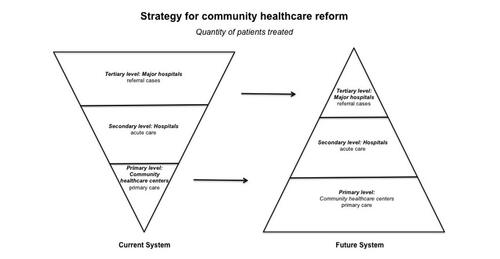
The conference, titled Forum on Community Health Services and Primary Health Care Reform, was held in June at the Stanford Center at Peking University (SCPKU) in Beijing. It featured distinguished policymakers, providers and researchers who discussed a wide-range of topics from China’s emerging “hierarchical medical system” for referring patients to the appropriate level of care (fenji zhenliao), as well as the practice and challenges of innovative approaches to primary care and integrated medical care systems. Yongquan Chen, director of Yong’an City Hospital and representative for the mayor’s office of Sanming, talked about health reforms in Sanming City, Fujian Province, a famous example within China. He discussed the incentives and reasoning behind the reforms, which focus on removing incentives for over-prescription of medications, demonstrating government leadership for comprehensive reforms, consolidating three agencies into one, monitoring implementation and easing tensions between doctors and patients. He pointed out the feasibility and early successes of reform by comparing public hospitals in the city in terms of their revenues and costs, reduced reliance on net revenue from medication sales, and other dimensions of performance. Finally, he addressed reform implementation and future plans on both the hospital's and the government's part.

Xiaofang Han, former director of the Beijing Municipal Development and Reform Commission, shared her personal views on the challenges patients face in navigating China’s health system (kan bing nan) and the need to improve the structure of the delivery system, including a revision to the incentives driving over-prescription in China’s fee-for-service payment system. She emphasized that patients’ distrust of primary care providers can only be overcome by demonstrating improved quality (e.g. with a systematic training program for general practitioners, GPs), and that referral systems should be based on the actual capabilities of the clinicians, not their formal labels. To reach China’s goal of over 80 percent of patients receiving management and first-contact care within their local communities will require improved training and incentive programs for newly-minted MDs, a more flexible physician labor market, and innovations in e-health and patient choice regarding gatekeeping or “contract physician services” (qianyue fuwu).        

Guangde County People's Hospital Director Mingliang Xu spoke about practices and exploration of healthcare alliances and initiatives to provide transparent incentives linking medical staff bonuses to metrics of quality. Ping Zhu from Community Healthcare Service Development and Research Center in Ningbo addressed building solid relationships between doctors and residents and providing more patient-centered services.        

Professor Yingyao Chen from Fudan University School of Public Health discussed performance assessment of community health service agencies based on his research in Shanghai. He introduced the strengths and weaknesses of the incentives embedded in the assessment system for China’s primary care providers, and concluded with suggestions for future research. Dr. Linlin Hu, associate professor at Peking Union Medical College, discussed China's progress and challenges of providing universal coverage of national essential public health services.

Professor Hufeng Wang of Renmin University of China discussed China’s vision for a “hierarchical medical system”– bearing resemblance to “integrated care,” “managed care,” or NHS-like coordination of primary and specialized care – with examples of pilot reforms from Xiamen, Zhenjiang and Dalian cities. Dr. Zuxun Lu, professor of Tongji Medical College of Huazhong University of Science and Technology, also discussed hierarchical medical systems and declared that China currently had a “discounted gatekeeper system.”

Dr. Yaping Du of Zhejiang University presented his research on mobile technology for management of lipid levels and with the help of a volunteer, demonstrated “Dyslipidemia Manager,” a mobile app-based product for both patients and doctors. Innovative strategies for primary prevention of cardiovascular diseases in low- and middle-income countries were the focus of remarks by Dr. Guanyang Zou from the Institute for Global Health and Development at Queen Margaret University, including its connections to international experiences with China’s current efforts in that area.  

In sum, the 2016 Forum elicited lively, evidence-based discussions about the opportunities and challenges in improving primary care and sustaining universal coverage for China.  Plans are underway for convening the third annual ACON Biotech-Stanford AHPP Forum on Community Health Services and Primary Health Care Reform in June 2017 at SCPKU. Anyone with original research or innovative experiences with primary care in China may contact Karen Eggleston regarding participation in next year’s Forum. 

Hero Image
groupphotoscpku062216
Policymakers, healthcare providers and researchers gathered at Stanford Center at Peking University to discuss community health services and primary healthcare reform, Beijing, June 2016.
All News button
1
616 Serra StreetEncina Hall E301Stanford, CA94305-6055
(650) 724-5253 (650) 723-6530
0
ngan_do_kim.jpg Ph.D.

Ngan Do is the Developing Asia Health Policy Postdoctoral Fellow for the 2016-17 academic year.  She is strongly interested in health system related issues, especially health financing, human resources for health, and health care service delivery. She implemented comparison studies at regional level as well as imposed herself to field work in Cambodia, Lao, Philippines, Korea, and Vietnam. At Stanford, Ngan will work on the public hospital reforms in Asia, focusing on dual practice of public hospital physicians and provider payment reforms. Ngan achieved her Ph.D. degree in health policy and management at the College of Medicine, Seoul National University. She earned her master degree on public policy at the KDI School of Public Policy and Management in Seoul, Korea and her bachelor degree on international relations at the Diplomacy Academy of Vietnam (previously the Institute for International Relations). 

Developing Asia Health Policy Postdoctoral Fellow, 2016-17
Authors
News Type
News
Date
Paragraphs

A long line of research has shown that women live longer than men, yet according to Karen Eggleston, director of the Asia Health Policy Program, and four other Stanford health researchers, mortality rate differences between men and women are much more variable than previously thought, following predictable patterns. Life expectancy differs depending on time, location and socioeconomic circumstance, not on biological factors alone, according to their newly published findings.

The researchers found that women have greater resilience when faced with socioeconomic adversity in a developing country—living nearly 10 years longer than men on average—but this pattern changes as the country evolves. Developed countries typically have smaller gaps in mortality rates between men and women than developing countries do.

Japan and South Korea are outliers, however, with higher mortality rate differences between men and women than is average for developed countries. In addition to the prevalence of male smoking, one possible explanation they draw is the lack of career-related opportunities for women in Japan and South Korea, two countries that have low gender wage equity among Organisation of Economic Co-operation and Development members.

Eggleston, who is part of the core faculty at the Shorenstein Asia-Pacific Research Center, et al. suggested the idea that reducing gender inequality may help narrow the mortality gap: men increase years lived when fewer barriers for women exist, but concluded that their findings supporting this conclusion merit further inquiry.

Their findings were published in the August edition of SSM – Population Health and highlighted in an earlier column on Voxeu.

Hero Image
woman walking tokyo
A woman walking in Tokyo, Japan.
Getty Images/Kiyoshi Ota
All News button
1
Authors
News Type
News
Date
Paragraphs

When is the last time you took a good, hard look at your health insurance options? Do you know what changes were made to your plan last year?

If the answer is “no,” you are not alone.

According to a new study by Maria Polyakova, assistant professor of health research and policy and Stanford Health Policy core faculty member, most Medicare Part D enrollees do not change their plans from year to year — even though plans can change drastically.

The study, recently published in the American Economic Journal: Applied, asserts that nudging consumers to re-evaluate their coverage could save them around $500 per year in out of pocket spending and premiums.

What is Medicare Part D?

Implemented in 2006, Part D allows Medicare users to purchase prescription drug coverage. Plans are administered by private insurance companies, but are heavily subsidized and regulated by the federal government. Consumers choose from more than 30 plans in their home state and are able to switch during a yearly open-enrollment period.

About 40 million people in the United States are enrolled in a Part D plan.

But Polyakova finds that “people do not seem to be switching contracts very often. At the same time, the contracts are changing quite dramatically every year.”

Though the study does not examine why consumers failed to switch, the data suggests that changing plans can be costly. Not necessarily a financial cost, but likely one of time or energy.

Thoroughly examining more than 30 plans on a yearly basis can be a burden, and changes are not always easy to detect.

“There are many other features of Part D plans that may change, so even if premiums appear the same, insurers may have changed other parts of coverage, such as deductible levels, co-pays and co-insurance, as well as which drugs are included,” said Polyakova.

Because the Part D market as a whole is dynamic, consumers can lose money even when their plan is stable.

“Even if your specific plan doesn’t change much, it is possible that it is not the best plan anymore because other plans change.”

Consumers tend to stick with the plan they picked when they first signed up. As a result, the study observes that individuals with similar needs may find themselves enrolled in very different plans if they made their first enrollment choices in different years.

This suggests that while most people likely try to pick the best coverage initially, they do not tend to re-evaluate their coverage each year in a way that fits their needs.

How can we improve coverage choices?

Polyakova believes that if the U.S. government were to more actively remind people to re-examine their plans during open enrollment, they could save consumers 20 to 30 percent.

Some researchers worry that improving individual choices and encouraging consumers to update their coverage could negatively affect the insurance market through “adverse selection.”

For example, individuals who are fairly healthy might tend to choose less generous plans than those who are relatively sick. If all those in poorer health end up in one plan, and there are no relatively low-spending enrollees to counteract the risk, the generous plan can become unsustainable.

However, the study finds evidence suggesting that for Part D, reminders to re-examine plans are unlikely to cause issues from adverse selection.

The federal government has implemented risk adjustment policies, or ways to combat the negative effects of adverse selection, that work to keep the market from unraveling. The government provides higher subsidies for sicker patients, pays the majority of patient costs and caps insurers’ profits and losses.

“From the point of view of the government, it seems that it is worthwhile to remind people who are already enrolled to reconsider their choices and potentially explain the differences across plans,” said Polyakova.

As the Affordable Care Act (ACA) changes coverage for Part D plans, reminding enrollees to re-examine their choices will become even more important. The ACA will substantially increase coverage, and plans could change considerably as a result.

What does this mean for the health insurance market?

While the study focuses specifically on Medicare Part D, Polyakova believes these findings likely translate to other areas of health insurance, particularly coverage under the ACA, which has many similar policies.

“The idea that we should remind consumers to re-evaluate plans has already been quite influential in the ACA policy debate,” said Polyakova. “Policymakers are tracking whether consumers are switching plans from one year to the next.”

She argues that in a consumer-driven economy, people must be able to easily make choices between products, in this case health insurance plans, for the market to function. But because choosing takes so much time and plan features are not always transparent, the forces driving the market may become weak.

Educating people about the financial benefits of switching plans could help the insurance market get back on track.

“People should try to reconsider their health risk and their insurance choices during every enrollment period,” Polyakova said. “Because if they don’t, it could have serious financial implications.”

Hero Image
medicared John Moore/Getty Images
All News button
1
News Type
News
Date
Paragraphs

The Asia Health Policy Program at Stanford’s Shorenstein Asia-Pacific Research Center, in collaboration with scholars from Stanford Health Policy's Center on Demography and Economics of Health and Aging, the Stanford Institute for Economic Policy Research, and the Next World Program, is soliciting papers for the third annual workshop on the economics of ageing titled Financing Longevity: The Economics of Pensions, Health Insurance, Long-term Care and Disability Insurance held at Stanford from April 24-25, 2017, and for a related special issue of the Journal of the Economics of Ageing.

The triumph of longevity can pose a challenge to the fiscal integrity of public and private pension systems and other social support programs disproportionately used by older adults. High-income countries offer lessons – frequently cautionary tales – for low- and middle-income countries about how to design social protection programs to be sustainable in the face of population ageing. Technological change and income inequality interact with population ageing to threaten the sustainability and perceived fairness of conventional financing for many social programs. Promoting longer working lives and savings for retirement are obvious policy priorities; but in many cases the fiscal challenges are even more acute for other social programs, such as insurance systems for medical care, long-term care, and disability. Reform of entitlement programs is also often politically difficult, further highlighting how important it is for developing countries putting in place comprehensive social security systems to take account of the macroeconomic implications of population ageing.

The objective of the workshop is to explore the economics of ageing from the perspective of sustainable financing for longer lives. The workshop will bring together researchers to present recent empirical and theoretical research on the economics of ageing with special (yet not exclusive) foci on the following topics:

  • Public and private roles in savings and retirement security
  • Living and working in an Age of Longevity: Lessons for Finance
  • Defined benefit, defined contribution, and innovations in design of pension programs
  • Intergenerational and equity implications of different financing mechanisms for pensions and social insurance
  • The impact of population aging on health insurance financing
  • Economic incentives of long-term care insurance and disability insurance systems
  • Precautionary savings and social protection system generosity
  • Elderly cognitive function and financial planning
  • Evaluation of policies aimed at increasing health and productivity of older adults
  • Population ageing and financing economic growth
  • Tax policies’ implications for capital deepening and investment in human capital
  • The relationship between population age structure and capital market returns
  • Evidence on policies designed to address disparities – gender, ethnic/racial, inter-regional, urban/rural – in old-age support
  • The political economy of reforming pension systems as well as health, long-term care and disability insurance programs


Submission for the workshop

Interested authors are invited to submit a 1-page abstract by Sept. 30, 2016, to Karen Eggleston at karene@stanford.edu. The authors of accepted abstracts will be notified by Oct. 15, 2016, and completed draft papers will be expected by April 1, 2017.

Economy-class travel and accommodation costs for one author of each accepted paper will be covered by the organizers.

Invited authors are expected to submit their paper to the Journal of the Economics of Ageing. A selection of these papers will (assuming successful completion of the review process) be published in a special issue.


Submission to the special issue

Authors (also those interested who are not attending the workshop) are invited to submit papers for the special issue in the Journal of the Economics of Ageing by Aug. 1, 2017. Submissions should be made online. Please select article type “SI Financing Longevity.”


About the Next World Program

The Next World Program is a joint initiative of Harvard University’s Program on the Global Demography of Aging, the WDA Forum, Stanford’s Asia Health Policy Program, and Fudan University’s Working Group on Comparative Ageing Societies. These institutions organize an annual workshop and a special issue in the Journal of the Economics of Ageing on an important economic theme related to ageing societies.


More information can be found in the PDF below.


Hero Image
Flickr/Vinoth Chandar Flickr/Vinoth Chandar
All News button
1
Authors
Beth Duff-Brown
News Type
News
Date
Paragraphs

Triage nurses typically assign patients to emergency room doctors who are on call or working a shift. But what if the doctors themselves determine whom among them is better suited to take on the next patient?

Classic economic theory predicts “moral hazard” in teams, which means one member behaves inefficiently because in the end someone else will pay the consequences. Yet many successful organizations promote teamwork.

So how does this puzzle relate to health care?

This is the question that Assistant Professor of Medicine David Chan, a core faculty member at Stanford Health Policy, tackles in his new study in the Journal of Political Economy.

Emergency departments (ED) nationwide cost a combined $136 billion to run each year, significantly impacting the growing health-care sector of the U.S. economy. Visits to the emergency rooms are increasing despite the implementation of the Affordable Care Act, causing them to be overcrowded and underfunded.

Chan studied two organizational models: one in which physicians are assigned patients in a nurse-managed system and one in which the doctors divide patients among themselves in a self-managed system.

“I find evidence that physicians in the same location have better information about each other and that, in the self-managed system, they use this information to assign patients,” Chan writes.

He said that by simply allowing physicians to choose patients, a self-managed system reduces emergency room lengths of stay by 11-15 percent, relative to the nurse-managed system.

“This effect occurs primarily by reducing a `foot-dragging’ moral hazard, in which physicians delay patient discharge to forestall new work,” Chan writes. A triage nurse is often in another room and has a difficult time observing true physician workload, whereas peer physicians who work together can.

“So, for example, if there are two physicians working at a time when there are a whole bunch of patients in the waiting room, then each physician knows that the minute he discharges a patient, he is more likely to get another one,” Chan said in an interview. This might lead the physician to dilly-dally on the release of that patient, knowing that he’ll immediately be signed another before he gets a break.

However, two physicians who can observe how busy the other one truly is will be less likely to stall, even if they want to avoid new patients.

Chan studied a large, academic emergency room that treated 380,699 patients over a six-year period. He looked at length of stay, measuring each physician’s individual contribution. He also observed patient demographics and used the Emergency Severity Index, an ED triage algorithm based on a patient’s pain level, mental status, vital signs and medical condition.

Besides measuring the effect of the self-managed system in this large hospital, Chan combined evidence to support the hypothesis that teamwork improves outcomes because of mutual management with better information.

He found that the only difference in outcomes between the two organizational systems was foot-dragging. Clinical outcomes or even the number of tests ordered were about the same under a self-managed or nurse-managed system.

Moreover, the foot-dragging behavior grows as physicians may anticipate future work by the number of patients in the waiting room, even if they end up seeing the same number of patients.

Finally, physicians refrain from this behavior when being watched by another physician in the same location, even in the nurse-managed system, when that other physician does not otherwise have any role in the physician’s patient care.

“I think the biggest takeaway is that such efficiency gains can be widespread in health care, particularly because there is so much at stake hidden behind information in patient care that is not transparent,” Chan said.

“Even if we don’t fully anticipate all of these gains, we could still achieve a lot by tinkering and using these changes as natural experiments to figure out what works and what doesn’t,” Chan said. “We can further use these results, particularly the evidence pointing at a mechanism, to think of what other innovations might work.”

Hero Image
emergency room
All News button
1
News Type
News
Date
Paragraphs

More than fifty experts met in Xi’an, China, for an international academic conference on demographic change and social development last week. Several scholars from the Freeman Spogli Institute for International Studies (FSI) spoke at the conference, including Karen Eggleston, Marcus Feldman, Jean Oi and Scott Rozelle.

The conference marked the 120th anniversary of Xi’an Jiaotong University’s founding and more than three decades of collaboration with Stanford scholars. Researchers at Xi’an Jiaotong University’s Institute for Population and Development Studies collaborate on policy-relevant research and educational activities with Stanford faculty at FSI as well as the Morrison Institute and Woods Institute.

For more information on FSI’s work in the areas of global health and medicine, please visit this page and the Asia Health Policy Program website.

Image
xian group

Hero Image
xian summit logo
All News button
1
Authors
News Type
Q&As
Date
Paragraphs

In a Q&A, Stanford postdoctoral fellow Darika Saingam explains why Thailand's battle against drugs continues and what is needed to introduce good policy that works to prevent illegal drug trade and supports recovering addicts.

Despite Thailand’s decade-long crackdown on drugs, demand for illegal substances has risen. A green leaf drug known as ‘kratom’ is a symbol of this rise as young people eagerly adopt the drug for entertainment and join an older generation of laborers who chewed it to survive long hours of work in the fields—and are now heavily addicted. Curtailing substance abuse and its consequences takes good public policy and solutions must be area-specific and evidence-based, according to a Stanford postdoctoral fellow.

Darika Saingam, the 2015-16 Developing Asia Health Policy Postdoctoral Fellow, has conducted two cross-sectional surveys and more than 1,000 interviews with drug users, recovered addicts, and local public officials in an effort to better understand the evolution of substance abuse in southern Thailand.

At Stanford, she is preparing two papers that offer policy options suitable for Thailand and other developing countries in Southeast Asia. Saingam spoke with the Shorenstein Asia-Pacific Research Center (APARC) where she will give a public talk on May 17. The interview text below was edited for brevity.

For decades, Thailand has been an epicenter of drugs. Can you describe the extent of the problem today?

According to a 2014 report, 1.2 million people were involved in illegal drug activities across Thailand. The total number of drug cases saw a 41 percent increase from 2013 to 2014. New groups of drug traffickers are mobilizing while existing groups are still active. Drug users who are young become drug dealers as they get older. The number of drug users below 15 years of age has increased dramatically.

According to your research, what drives Thais toward illegal drug use and the trafficking business?

Adults in Thailand use drugs to relieve stress and counteract the effects of work. Adolescents use them for entertainment. Historically, farmers and laborers from rural areas of Thailand would use opium for pain relief. More recently, a consumable tablet known as yaba has become popular along with crystal methamphetamine and marijuana. Young people are increasingly using yaba and kratom.

Thailand is still a developing country, but it is industrializing quickly. Social and cultural norms have been shifting and people want an improved quality of life. A lot of young people are unemployed and lack social support and are therefore more likely to turn to drug trafficking for economic opportunity. The economic recession and political strife in countries bordering Thailand have exacerbated the situation.


Image
drug policy 1a
    
Image
drug policy 2

Photos (left to right): A man holds up a kratom leaf. / Saingam examines kratom leaves as part of her research to understand illegal cultivation practices.


What is kratom and why is it popular?

For nearly a century, the native people of Thailand have chewed kratom. It is a leaf that grows on trees resembling a coffee plant. Historically, kratom was used to reduce strain following physical labor, to be able to work harder and longer, and to better tolerate heat and sunlight. Kratom is also embedded in Thai culture and given as a spiritual offering in religious ceremonies. My field research in the southern province of Nakhon Si Thammarat has shown that these motivations are still true today.

Within the past seven years, kratom use has skyrocketed and people are using it in increasingly harmful ways. Chewing kratom is not immediately harmful to health, but combining it with other substances is. This is the recent trend. Users have created new ways to consume it such as in a drink known as a ‘4x100.’ It contains boiled kratom leaves, cough syrup and soft drinks. Additional methamphetamines and benzodiazepines are sometimes added to that mixture.

What strategies must be employed to control substance abuse?

The first step is to realize that the patterns of substance abuse are specific to each location therefore solving the problem must also be. Drug usage is also dynamic. Placing hard control measures on one substance often provokes the emergence of another in its place therefore a holistic approach is important.

Thailand should employ multiple strategies toward effective prevention and control of substance abuse. These strategies include examining the problem and creating policies from an economic perspective (supply and demand), an institutional perspective (national and international drug control cooperation), and a social perspective (structural supports for recovered addicts and mobilization of public participation).


What is the Thai government doing to address the drug problem, and what could they be doing better?

Politicians in Thailand must do a better job at representing the people. Government health workers are often gathering information, assessing needs, and reporting findings to politicians, but these needs are not being accurately addressed. An example of this is politicians ordering to cut down kratom trees – a public display that does not get at the root cause of the problem. The reality is that drug users will quickly find substitutes. According to my study, of the regular users that stopped using kratom, more than 50 percent turned to alcohol instead and did so on a daily basis. This is merely a shift from one substance to another.

On the upside, a crop substitution program created under King Bhumibol Adulyadej offers a successful working model. The program works to replace opium poppy farming with cash crop production. It began in 1969 and is cited for helping an estimated 100,000 people convert their drug crop production to sustainable agricultural activities. Crops cultivated can be sold for profit in nearby towns. The program has also introduced a wide variety of crops and discouraged the slash-and-burn technique of clearing land. It is win-win because it stymies drug trade and provides economic opportunity while also being ecologically sound. This type of program should continue to be scaled up.

Can this model be co-opted elsewhere? What lessons from other countries could inform Thailand’s approach?

Yes, the model could plausibly be implemented in other areas in Thailand and in other Southeast Asian nations.

I think a judicial mechanism such as the kind seen in France could benefit the rural areas in Thailand. The French government has established centers across the country that act as branches of the court that try delinquency cases of minor to moderate severity, and also recommend support services for drug users. Members of the magistrate and civil society actors manage center operations thus placing some responsibility back onto the local community.

I believe an opportunity also exists for Thailand to legalize kratom. Legalization would show a respect for the cultural tradition of chewing kratom leaves and allow the government to suggest safer ways of using it. Bolivia has created a successful model of this through its legalization of coca leaves. Coca in its distilled form is cocaine, but left as a leaf, it is not a narcotic. Indigenous peoples are allowed to chew coca leaves. The government policy is being credited for a decrease in cocaine production as well.

Hero Image
drug policy headline
Stanford postdoctoral fellow Darika Saingam conducts interviews and collects data in southern Thailand.
All photos courtesy of Darika Saingam
All News button
1
Subscribe to Health care institutions