World Bank
-

A year has passed since the Japanese government embarked on the new economic policy package called “Abenomics” with three “arrows”: aggressive monetary easing, flexible fiscal policy, and a growth strategy. The package is designed to bring the Japanese economy out of 20 years of stagnation and 15 years of deflation, and put it on a sustainable growth path. How effective has the policy package been during the first year of the Abe administration?  Will it succeed in bringing sustainable growth to Japan?  Professor Takatoshi Ito, a prominent expert on the Japanese economy, tackles these questions.

Takatoshi Ito, Professor at Faculty of Economics and Dean of Graduate School of Public
Policy, University of Tokyo, has taught extensively both in the United States and Japan,
including at University of Minnesota, Hitotsubashi University, and Harvard University.
He held visiting professor positions at Harvard University (1986-87 and 1992-94), Stanford
University (as National Fellow; 1984-85); Columbia Business School (fall semester, 2009),
and Tun Ismail Ali Chair Professor at University of Malaya (summer semester, 2008). His
public sector experiences include Senior Advisor in the Research Department, IMF
(1994-97); Deputy Vice Minister for International Affaires at Ministry of Finance
(1999-2001); and a member of the Prime Minister’s Council of Economic and Fiscal
Policy (2006-08). He is an author of many books including The Japanese Economy (MIT
Press), The Political Economy of the Japanese Monetary Policy (MIT Press), and
Financial Policy and Central Banking in Japan (MIT Press), and more than 50
refereed academic journal articles on international finance and the Japanese economy,
including ones in American Economic Review and Econometrica. He has distinguished
academic and research appointments such as President of the Japanese Economic
Association in 2004; Fellow of Econometric Society, since 1992; Research Associate at
National Bureau of Economic Research since 1985; and Faculty Fellow, Centre for
Economic Policy Research, since 2006. His research interest includes capital flows and
currency crises, microstructures of the foreign exchange rates, and inflation targeting. He
contributes frequently op-ed columns and articles to Financial Times, Nihon Keizai Shinbun,
Mainichi Shinbun, and Toyo Keizai Weekly.

Philippines Conference Room

Takatoshi Ito Speaker University of Tokyo
Seminars
-

Image


Abstract:

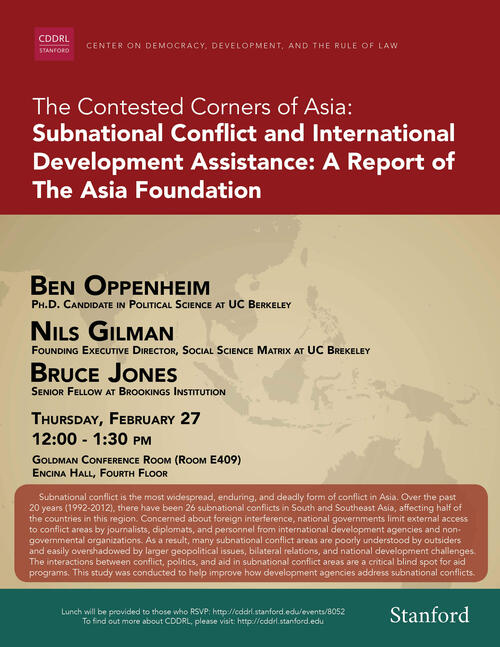
Subnational conflict is the most widespread, enduring, and deadly form of conflict in Asia. Over the past 20 years (1992-2012), there have been 26 subnational conflicts in South and Southeast Asia, affecting half of the countries in this region. Concerned about foreign interference, national governments limit external access to conflict areas by journalists, diplomats, and personnel from international development agencies and non-governmental organizations. As a result, many subnational conflict areas are poorly understood by outsiders and easily overshadowed by larger geopolitical issues, bilateral relations, and national development challenges. The interactions between conflict, politics, and aid in subnational conflict areas are a critical blind spot for aid programs. This study was conducted to help improve how development agencies address subnational conflicts.


Speaker Bios:

Ben Oppenheim is a Fellow (non-resident) at the Center on International Cooperation at New York University. His research spans a diverse set of topics, including fragile states, transnational threats (including pandemic disease risks and terrorism), and the strategic coherence and effectiveness of international assistance in fragile and conflict-affected areas.

Oppenheim has consulted for organizations including the World Bank, the United Nations, the Asia Foundation, the Institute for the Future, and the Fritz Institute, on issues including organizational learning, strategy, program design, foresight, and facilitation. In 2009, he served as Advisor to the first global congress on disarmament, demobilization, and reintegration, supported by the World Bank and the UN.

In 2013, Oppenheim was a visiting fellow at the Uppsala University Forum on Democracy, Peace, and Justice. His research has been supported by a Simpson Fellowship, and a fellowship with the Institute on Global Conflict and Cooperation. He was also a research fellow with UC Berkeley's Institute of International Studies, affiliated with the New Era Foreign Policy Project.


Nils Gilman is the Executive Director of Social Science Matrix. He holds a B.A., M.A. and Ph.D. in History from the University of California, Berkeley. Gilman’s first scholarly interest was in American and European intellectual history, with a particular focus on the institutional development of the social sciences, the lateral transfer and translation of ideas across disciplinary boundaries, and the impact of social scientific ideas on politics and policy.

Gilman is the author of Mandarins of the Future: Modernization Theory in Cold War America (Johns Hopkins University Press, 2004), the co-editor of Staging Growth: Modernization, Development, and the Global Cold War (University of Massachusetts Press, 2003) and Deviant Globalization: Black Market Economy in the 21st Century (Continuum Press, 2011), as well as the founding Co-editor of Humanity: An International Journal of Human Rights, Humanitarianism, and Development. He also blogs and tweets.

Prior to joining Social Science Matrix in September 2013, Gilman was research director at Monitor 360, a San Francisco consultancy that addresses complex, cross-disciplinary global strategic challenges for governments, multinational businesses, and NGOs. He has also worked at a variety of enterprise software companies, including Salesforce.com, BEA Systems, and Plumtree Software. Gilman has taught and lectured at a wide variety of venues, from the Harvard University, Columbia University, and National Defense University, to PopTech, the European Futurists Conference, and the Long Now Foundation.


Bruce Jones is a senior fellow and the director of the Project on International Order and Strategy in the Foreign Policy program at the Brookings Institution. He is also the director of the Center on International Cooperation at New York University.

Jones served as the senior external advisor for the World Bank’s 2011 World Development Report, Conflict, Security and Development, and in March 2010 was appointed by the United Nations secretary-general as a member of the senior advisory group to guide the Review of International Civilian Capacities. He is also consulting professor at the Center for International Security and Cooperation at Stanford University and professor (by courtesy) at New York University’s department of politics.

Jones holds a Ph.D. from the London School of Economics, and was Hamburg fellow in conflict prevention at Stanford University.

He is co-author with Carlos Pascual and Stephen Stedman of Power and Responsibility: Building International Order in an Era of Transnational Threats (Brookings Press, 2009); co-editor with Shepard Forman and Richard Gowan of Cooperating for Peace and Security (Cambridge University Press, 2009); and author of Peacemaking in Rwanda: The Dynamics of Failures(Lynne Reinner, 2001).

Jones served as senior advisor in the office of the secretary-general during the U.N. reform effort leading up to the World Summit 2005, and in the same period was acting secretary of the Secretary-General’s Policy Committee. In 2004-2005, he was deputy research director of the High-level Panel on Threats, Challenges and Change. From 2000-2002 he was special assistant to and acting chief of staff at the office of the U.N. special coordinator for the Middle East peace process. 

Richard and Rhoda Goldman Conference Room

Ben Oppenheim Ph.D. Candidate in Political Science Speaker UC Berkeley
Nils Gilman Founding Executive Director, Social Science Matrix Speaker UC Berkeley
Bruce Jones Senior Fellow Speaker Brookings Institution
Seminars
-

Abstract:
The peoples of Burma/Myanmar have faced military rule, human rights violations, and poor health outcomes for decades. The country Is now undergoing a political liberalization, and multiple changes in political, social and economic life. The human rights and health situation of the country's many ethnic nationalities remain challenging, and represent one of the clearest threats to the prospect of successful transition to peace, and to democracy. We will explore the current health and human rights situation in the country, the ongoing threats to peace, and ways forward for this least developed nation as it emerges from 5 decades of military rule.

Chris Beyrer MD, MPH, is a professor of Epidemiology, International Health, and Health, Behavior, and Society at the Johns Hopkins University Bloomberg School of Public Health. He is the founding Director of the University¹s Center for Public Health and Human Rights, which seeks to bring the tools of population-based sciences to bear on Health and rights threats. Dr. Beyrer also serves as Associate Director of the Johns Hopkins Centers for AIDS Research (CFAR) and of the Center for Global Health. He has been involved in health and human rights work with Burmese populations since 1993. Prof. Beyrer is the author of more than 200 scientific papers, and author or editor of six books, including War in the Blood: Sex, Politics and AIDS in Southeast Asia, and Public Health and Human Rights: Evidence-Based Approaches. He has served as a consultant and adviser to numerous national and international institutions, including the National Institutes of Health, the World Bank, WHO, UNAIDS, the Open Society Foundations, the Walter Reed Army Institute for Research, amfAR The Foundation for AIDS Research, Physicians for Human Rights and Human Rights Watch. Dr. Beyrer received a BA in History from Hobart and Wm. Smith Colleges, his MD from SUNY Downstate in Brooklyn, NY, and completed his residency in Preventive Medicine, public health training, an MPH and a Infectious Diseases Fellowship at Johns Hopkins University in Baltimore. He received an honorary Doctorate (PhD) in Health Sciences from Chiang Mai University in Thailand, in 2012, in recognition of his 20 years of public health service in Thailand

Building 200 (History Corner)
Room 205
Stanford University

Chris Beyrer Director Speaker Johns Hopkins Center for Public Health & Human Rights
Seminars
-

At the November 2013 Third Plenum, China’s leaders committed to an ambitious program of economic reform.  Now their challenge is to convert those commitments into a realistic and sustained program of change.  Barry Naughton, just back from fall term at Tsinghua University in Beijing, examines the achievements and obstacles, and discusses how these fit in with the other initiatives of Xi Jinping’s complex emerging agenda.

Barry Naughton is a professor at the University of California, San Diego.  He is one of the world’s top experts on the Chinese economy, and a long-term analyst of Chinese economic policy. Naughton received his Ph.D. in Economics from Yale University in 1986.  Naughton was named the So Kuanlok Professor at the Graduate School of International Relations and Pacific Studies (IR/PS) of the University of California at San Diego in 1998.  He has consulted extensively for the World Bank, as well as for corporate clients.  Naughton is a member of the Council on Foreign Relations and is a non-resident fellow of the Brookings Institution in Washington, D.C.  

This event is co-sponsored with CEAS and is part of the China under Xi Jinping series.

Philippines Conference Room

Barry Naughton Professor of Chinese Economy Speaker UCSD
Seminars

Encina Hall
616 Jane Stanford Way
Stanford, CA 94305-6055

0
Senior Fellow Emeritus at the Freeman Spogli Institute for International Studies
Professor, by courtesy, of Economics
marcel_fafchamps_2025.jpg

Marcel Fafchamps is a Senior Fellow Emeritus at the Freeman Spogli Institute for International Studies (FSI) and a member of the Center on Democracy, Development and the Rule of Law. Previously, he was the Satre Family Senior Fellow at FSI. Fafchamps is a professor (by courtesy) for the Department of Economics at Stanford University. His research interests include economic development, market institutions, social networks, and behavioral economics — with a special focus on Africa and South Asia.

Prior to joining FSI, from 1999-2013, Fafchamps served as professor of development economics in the Department of Economics at Oxford University. He also served as deputy director and then co-director of the Center for the Study of African Economies. From 1989 to 1996, Fafchamps was an assistant professor with the Food Research Institute at Stanford University. Following the closure of the Institute, he taught for two years at the Department of Economics. For the 1998-1999 academic year, Fafchamps was on sabbatical leave at the research department of the World Bank. Before pursuing his PhD in 1986, Fafchamps was based in Addis Ababa, Ethiopia, for 5 years during his employment with the International Labour Organization, a United Nations agency that oversees employment, income distribution, and vocational training in Africa.

He has authored two books: Market Institutions in Sub-Saharan Africa: Theory and Evidence (MIT Press, 2004) and Rural Poverty, Risk, and Development (Elgar Press, 2003), and has published numerous articles in academic journals.

Fafchamps served as the editor-in-chief of Economic Development and Cultural Change until 2020. Previously, he had served as chief editor of the Journal of African Economies from 2000 to 2013, and as associate editor of the Economic Journal, the Journal of Development Economics, Economic Development and Cultural Change, the American Journal of Agricultural Economics, and the Revue d'Economie du Développement.

He is a research associate of the National Bureau of Economic Research, an affiliated professor with J-PAL, a senior fellow with the Bureau for Research and Economic Analysis of Development, a research fellow with IZA, Germany, and with the Center for Economic and Policy Research, UK, and an affiliate with the University of California’s Center for Effective Global Action.

Fafchamps has degrees in Law and in Economics from the Université Catholique de Louvain. He holds a PhD in Agricultural and Resource Economics from the University of California, Berkeley. 

Curriculum Vitae

Publications 

Working Papers

Date Label
-

Co-sponsored by the Stanford Center for International Development

Under what conditions is decentralization most likely to foster development and reduce poverty?  Plausible answers include:  a sufficiently committed central government; local checks against corruption; and sufficiently resourced actors able to deliver public services effectively. Indonesia is a good place to explore the explanatory power of these and other propositions, thanks to the country’s diverse local conditions and the rapid and sweeping (“Big Bang”) decentralization that it underwent in the late 1990s.  In his disaggregation of the Indonesian case since then, Dr. Sumarto will examine whether, how, and why poverty alleviation has been helped or hurt by particular economic, social, and political variations in the context and character of local governments across the archipelago.

Sudarno Sumarto was an Asia Foundation Visiting Fellow at APARC in 2009-2010.  In 2001-2009 he was the director of SMERU, a highly regarded independent institute for research and public policy studies in Jakarta.  He has served as a consulting economist for the World Bank, the Asian Development Bank, among other organizations, and has taught in Indonesia’s leading universities. His latest publication is Explaining Regional Heterogeneity of Poverty:  Evidence from Decentralized Indonesia (co-authored, 2013).  Earlier titles include more than sixty co-authored books, working papers, articles, chapters, and reports on topics such as poverty, decentralization, employment, vulnerability, and economic growth.  His degrees in economics include a PhD and an MA from Vanderbilt University and a BSc from Satya Wacana Christian University (Salatiga).

Lunch will be served.

Philippines Conference Room

Sudarno Sumarto Senior fellow Speaker SMERU Research Institute
Seminars

Urbanization and obesity-related chronic diseases are cited as threats to the future health of India's older citizens. With 50% of deaths in adult Indians currently due to chronic diseases, the relationship of urbanization and migration trends to obesity patterns have important population health implications for older Indians. The researchers constructed and calibrated a set of 21 microsimulation models of weight and height of Indian adults. The models separately represented current urban and rural populations of India's major states and were further stratified by sex.

Subscribe to World Bank