
Israeli Attitudes Towards Democracy Are Shaped By Their Perceptions of the Health of American Democracy
Israeli Attitudes Towards Democracy Are Shaped By Their Perceptions of the Health of American Democracy
CDDRL Research-in-Brief [5-minute read]

Introduction and Contribution
A burgeoning literature considers the domestic causes and consequences of democratic backsliding for public perceptions of democracy but has yet to fully examine the role of international factors in explaining these perceptions. The effect of democratic backsliding in one
democracy on public support for democratic principles in other countries has, thus far, defied theoretical and empirical investigation. In “U.S. Democratic Backsliding and the Decline of Democratic Support Abroad,” Amnon Cavari, Amichai Magen, and Benjamin Yoel address this gap in knowledge. They propose and test a theory of the effects of backsliding on global opinion, in which information about democratic decline in one country can lead to diminished support for liberal democracy and increased support for authoritarian governance in another. To test this, they deployed an original survey experiment in Israel to examine the effect of two narratives about the 2020 U.S. elections — one signaling democratic decline and one signaling democratic resilience — on support for authoritarian governance. They found that respondents exposed to the narrative of U.S. democratic decline were more supportive of authoritarian governance than those exposed to the narrative of democratic resilience. Moreover, they find marginal evidence that the respondents’ ideological preferences condition the effect of narrative exposure. Cavari, Magen, and Yoel’s findings suggest that the democratic backsliding literature has insufficiently explored the global consequences of domestic events and processes for democratic decline worldwide.
Democratic erosion is both a supply- and demand-side phenomenon. On the supply side, leaders take anti-democratic actions, such as weakening checks on executive power, which they then justify to the public — on grounds of law and order, threats to the nation, and so on. On the demand side, varied types of social conflict, such as polarization or racial animus, can lead publics to endorse limits on democratic governance.
Real-life models of democratic erosion have ‘diffused’ across borders. For example, strongmen in countries neighboring Russia, such as Alexander Lukashenko and Viktor Orbán, have borrowed from Vladimir Putin’s playbook of jailing opponents and using anti-Western rhetoric. It is less clear, however, whether authoritarian phenomena in one country can prompt changes in the beliefs of ordinary people in other countries.
In “U.S. Democratic Backsliding and the Decline of Democratic Support Abroad,” Amnon Cavari, Amichai Magen, and Benjamin Yoel present results from a survey experiment conducted among Israelis following the January 6 United States Capitol attack. They find that respondents who were randomly exposed to a narrative about US democracy eroding were significantly more supportive of autocracy in Israel. By contrast, those exposed to a narrative about the resilience of US democracy after January 6 were less supportive. These effects were most pronounced among conservative Israelis, perhaps unsurprising given the associations between right-wing ideologies and authoritarianism.
Readers come away with a sense of the varied ways that democratic erosion can diffuse across borders, particularly at the micro level. That changes in American politics can affect the attitudes of Israelis over 6000 miles away suggests that autocrats can be highly effective in shaping the regime trajectories of their more immediate neighbors. This makes it all the more urgent to combat anti-democratic narratives before they take root and spread.
How Authoritarian Attitudes Diffuse
The authors make a straightforward claim: someone in country A who observes democratic norms or institutions being undermined in country B may well question the value of democracy for A. To see this, consider how Nayib Bukele’s campaign of mass imprisonment without due process in El Salvador has appealed to ordinary people across Latin America. In light of the social and economic problems facing democratic countries, unchecked strongmen — and their purported successes — have come to seem more credible and pragmatic.
Democratic erosion in country B should be especially likely to affect the beliefs of people in A when (1) B is a close ally of, or is seen as powerful or influential for A, and (2) events in B are widely covered in A’s traditional or social media. For example, coverage of the United Kingdom’s “Brexit” was shown to influence how people in other European Union countries viewed integration or withdrawal. The authors further posit that democratic erosion will have a larger effect on support for autocracy among those who subscribe to right-wing ideologies — these prioritize social order and religious or racial purity, which can conflict with inclusive democracy.
Backsliding in Israel and Ties to the United States
Israeli democracy has eroded in recent years, particularly as Benjamin Netanyahu’s Likud party has worked to undermine judicial independence and as discrimination against Arab and other ethnic minority Israelis persists. However, Israel’s backsliding also has strong demand-side components: majorities of those surveyed in 2023 agreed that a strong leader — one not limited by the legislature or judiciary — was necessary to solve Israel’s problems, that voting rights should be restricted among those unwilling to declare their loyalty to the state, and that international NGOs should be banned. The authors aim to show that these anti-democratic beliefs stem not only from elite rhetoric or national polarization, but from global backsliding.
The United States is Israel’s closest ally, and the two countries share much in terms of political and social life. Both were founded by groups fleeing persecution, who established a political culture defined by pioneer settlement and the displacement of indigenous peoples. The US has consistently supported Israel’s wars and military operations in the Middle East. A large majority of Israelis view the US as an exemplar of democracy and freedom. This makes Israel an ideal case for measuring how global democratic erosion affects democratic sentiment at home.
The Survey Experiment
The survey was fielded in March 2021, a time of acute political crisis in Israel: this marked the fourth election cycle in less than two years, and the prior two elections had resulted in parliamentary stalemates and short-lived governments. In the prior months, Israeli media had extensively covered Donald Trump’s efforts to overturn the 2020 elections and ensuing January 6 attack on the Capitol. 92% of survey participants reported following the US elections, and 43% reported doing so closely. A majority reported believing the US strongly influences Israeli politics.
Participants were randomly assigned to read one of two ‘vignettes’ about the 2020 elections. One emphasized that US democracy had faltered, as evidenced by Trump’s behavior and the Capitol attack. Another emphasized the resilience of US democracy, as evidenced by high turnout and the eventual transfer of power — this vignette did not mention January 6. The authors find that those who read the “US democracy faltering” vignette were significantly less likely to agree the US elections were free and fair.
Finally, the authors measure their dependent variable — support for autocracy — in terms of support for restricting speech that is hostile to the government, the permissibility of rule by strongmen, and so on. The key finding is that Israelis exposed to the “US democracy faltering” narrative were significantly more supportive of autocracy.
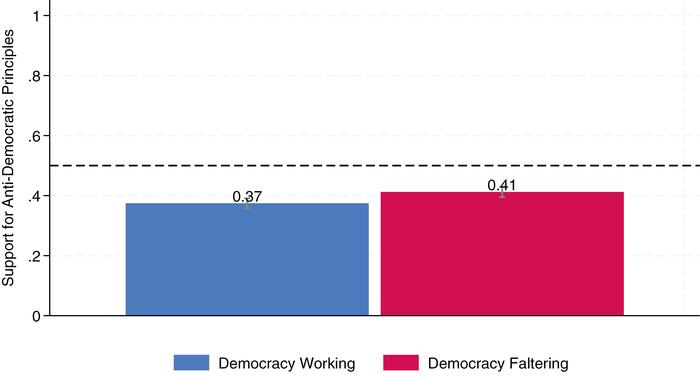
Figure 3. Support for Authoritative Governance, by Vignette.
These effects were most pronounced among those on the political right, but the main finding holds even when statistically controlling for ideology. In all, the study demonstrates that when democratic erosion diffuses, it can shape not only elite behavior but mass attitudes as well.
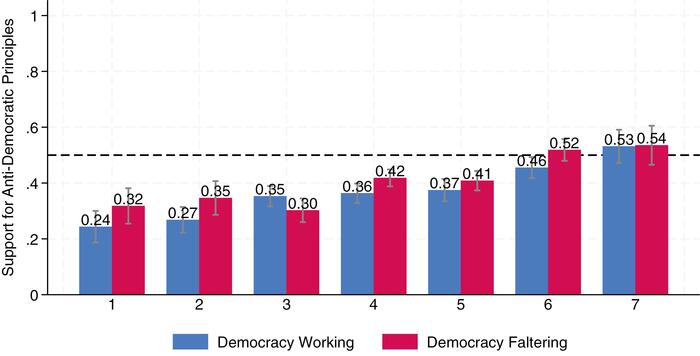
Figure 4. Effect of ideology on support for Authoritative Governance by Vignette.
*Brief prepared by Adam Fefer.