
Leadership Lessons from Thailand's "Almost Prime Minister" Pita Limjaroenrat
Leadership Lessons from Thailand's "Almost Prime Minister" Pita Limjaroenrat
Speaking on the latest episode of the APARC Briefing series, the Thai democracy champion opens up about his upbringing, offers insights from his newfound role in social activism, and shares why he continues to hold hope for reform in Thailand.
For Pita Limjaroenrat, Thailand’s liberal icon and “almost prime minister,” the experience of being banned from politics following his decisive 2023 general election win has only strengthened the calling to fight for democracy in his country.
Thailand’s distinctive power structure – an entrenched alliance among the monarchy, the military, and economic monopolies – has repeatedly undermined and dismantled democratic forces’ attempts to challenge the dominance of unelected institutions. “This is a systematic issue that if I don't stand up for, then it's going to happen to my daughter's generation and my granddaughter's generation,” Pita says.
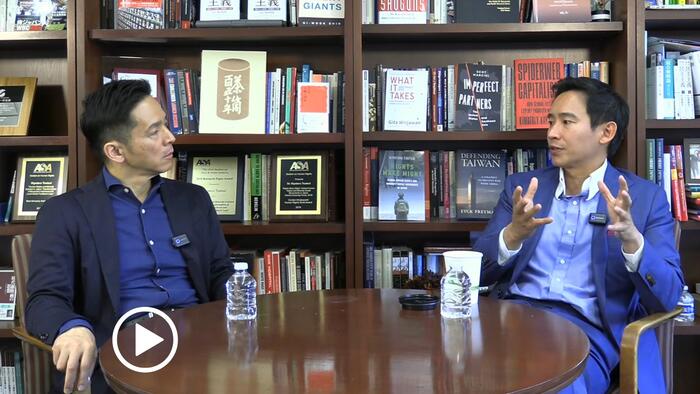
Joining APARC Director Kiyoteru Tsutsui on the latest episode of the APARC Briefing video series, Pita reflects on his journey, shares lessons in leadership and resilience, and discusses the forward-looking vision that continues to define his commitment to contribute to the conversation on Thailand’s future.
The APARC Briefing interview followed a fireside chat with Pita, Thailand at a Crossroads, hosted by APARC’s Southeast Asia Program, where he examined Thai politics and Southeast Asian regional dynamics.
Sign up for APARC newsletters to receive expert analysis and insights from our scholars and guests >
The People’s Mandate
In May 2023, Pita led the Move Forward Party (MFP) to win the most seats in Thailand’s general election on a platform of progressive reform. He was poised to lead the country, but a court injunction and parliamentary maneuvering halted his path to the prime ministership. In August 2024, the Thai Constitutional Court disbanded the MFP and banned Pita from politics for ten years. He may still face a lifetime ban. Rather than retreating, however, Pita has reframed his political setback as a summons to a larger mission.
To compartmentalize, find purpose in adversity, and manage anxiety, Pita proactively maps out worst-case scenarios, he revealed. “Once I have that down on paper, I stop worrying,” he said. Having anticipated the possibility of being blocked from power, the event, when it happened, was not a personal shock but the activation of a pre-analyzed outcome. This mindset allows him to see his ban from office as a reversible obstacle in a long-term struggle, citing the comebacks of leaders like Brazil’s President Lula da Silva.
Politics is a ball that could turn either way, Pita believes. “If there's enough mandate, if there's enough calling from the people that they want me to govern and they want me to run again, whatever legal procedure that is done to me can be reversed. A pathway to power is always there as long as you still have that fire in you and people give you the mandate,” he argues.
The Art of the Middle Way
Pita’s leadership philosophy is rooted in a life spent bridging divides. Describing himself as a “jack of all trades,” he recalled how, as a child, he moved easily between being a bookworm and taking on leadership roles in school and basketball. He traces this identity back to his upbringing, which included a middle-class childhood in Bangkok, formative years at an all-boys school in rural New Zealand, and an education and professional experiences in both the public and private sectors, with degrees earned from Harvard’s Kennedy School and MIT’s Sloan School of Management.
“That became who I am,” he stated, outlining his unique proposition to Thai voters. “Someone who understands international markets and rural areas. Someone who's middle class, who understands people who are well off and people who are struggling [...] Someone who understands both the private side and public side because he prepared himself that way.”
This dual expertise, he argued, is crucial for effective governance. He noted the fundamental difference in objectives between the two sectors. “The goal of public service is service. The goal of the private sector is profitability,” he said. “Just because you're a successful businessman doesn't make you a successful politician.”
He recounted how his political calling was ignited in the wake of the 2004 Indian Ocean tsunami, when, as a management consultant, he worked on a tourism recovery strategy for Thailand. The intellectual challenge of balancing complex public needs, like national energy security, sparked a passion that private-sector work couldn't match.
From Campaign to Campus
Now a Senior Democracy Fellow at Harvard Kennedy School, Pita channels his experiences into mentoring a new generation of leaders. He teaches a class on running for public office in developing countries, hosts workshops, and holds “private office hours” for students committed to entering public service, helping them craft their first campaign strategies. It is a way of “turning reality into a textbook” for others.
He also remains a keen observer of global affairs, characterizing the current U.S.-China relationship as a “managed rivalry” or “competitive coexistence,” where deep distrust is checked by the understanding that a full-fledged decoupling would be “economic suicide” for both sides. He sees Southeast Asia as a central and crucial bloc of “swing states” that must leverage its position to determine its own future without being forced to choose sides in the competition between the world’s two greatest powers.
When asked for his message to young people, Pita’s advice is a blend of passion and pragmatism. “Always follow your heart, but take your brain with you,” he urged. For those with aspirations to tackle the world’s crises and pressing social challenges, he stressed the importance of pairing that fire with a concrete plan.
“It's up to you whether you find your North Star, improve your skills to have a plan to get there,” he concluded.
Pita clearly articulates what he wants: a more just and democratic Thailand. Even from outside the halls of political power, he is methodically working on his plan to get there. “I can wait for my time, and I will come back stronger, more vigorous, more capable, and more relevant.”


