
Transnational Repression, Discrimination, and Well-Being Among Russian Emigrants
Transnational Repression, Discrimination, and Well-Being Among Russian Emigrants
CDDRL Research-in-Brief [3.5-minute read]

Introduction and Contribution:
Russia’s 2022 invasion of Ukraine has significantly undermined European security and Ukraine’s sovereignty, claimed hundreds of thousands of lives, and arguably solidified Vladimir Putin’s authoritarian grip on power. Aside from these more obvious consequences, around one million Russians have emigrated, changing the domestic politics of dozens of countries across Europe, Asia, and North America.
Russian emigrants not only face discrimination, integration difficulties, and economic precarity in their host countries, but also the threat of “transnational repression.” This includes Russia seizing their property or revoking their citizenship, harassing their relatives who stayed behind, and surveilling them in their host countries. There have even been reports of activists and journalists being poisoned outside of Russia. What does transnational repression mean for the lives of ordinary Russian migrants?
In “Invisible costs of exiting autocracy,” Ivetta Sergeeva and Emil Kamalov show that these varied challenges and threats — especially fear of Russian repression and host country discrimination — have had a considerable impact on emigrants’ subjective well-being. Using original survey and interview data collected as part of the ambitious OutRush project, the authors draw our attention to the many psychological hardships faced by Russians abroad simply because they are citizens of a belligerent authoritarian state.
Data and Variables:
Surveys and interviews were conducted between August and September 2022 with over 2,500 emigrants. “Invisible Costs” focuses on Russians living across more than 60 countries, with interviews conducted in five popular destinations: Georgia, Kazakhstan, Kyrgyzstan, Armenia, and Serbia.
Sergeeva and Kamalov draw on a standard conception of subjective well-being as having ‘affective’ and ‘cognitive’ components. Affective well-being is operationalized in terms of how often survey respondents have felt sadness, depression, and happiness over the last three months, and cognitive well-being in terms of levels of life satisfaction. Migrant experiences ought to affect these two components differently; for example, the threat of transnational repression may significantly reduce happiness while leaving life satisfaction unchanged. As prior research has shown the importance of economic and social variables for migrant integration, the authors also include measures of income, employment, and interaction with locals.
Results:
The survey data paint a fairly bleak picture of the emigrant experience. Over 60% of respondents reported being somewhat or very afraid of transnational repression, while only 9% expressed no such fear. Interviewees often linked these fears to at least two factors: (1) concern for the well-being of relatives still in Russia and (2) awareness of the presence of Russian agents in host countries. The statistical analysis shows that fear of transnational repression had a statistically significant (negative) correlation with affective well-being. However, it is not a significant predictor of cognitive well-being, which makes sense, as the high risks of repression in Russia make emigration seem like a rational life choice.
Meanwhile, 22% reported experiencing discrimination. This is much higher than the OECD-wide average of 15% for migrants — the highest single-country percentage in these surveys is just 21%. In Poland and Georgia — both having a history of violent conflict with Russia — 36% and 39% of emigrants reported experiencing discrimination, respectively. For example, one interviewee reported walking into a Georgian coffee shop, scanning a QR code, and then pictures with captions saying “you’re terrorists, go away” popping up on their phone instead of the menu. Self-reported discrimination is shown to have a statistically significant effect on both types of well-being.
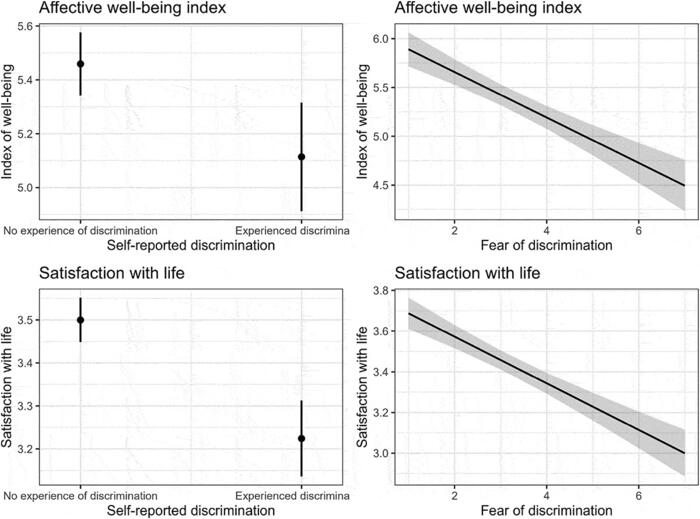
Figure 3. Effect of discrimination, experienced and feared, on subjective well-being. The index of affective well-being represents an affective component of subjective well-being, while satisfaction with one’s life represents the cognitive component. Variables are presented in their original scales without standardization. Models with original scales are presented in online appendix D.
41% of respondents merely feared discrimination. This fear appears driven less by migrants’ negative experiences in their host countries and more by the risk of discrimination leading to deportation. Interviewees seem to assess this risk with reference to the high number of visa rejections they observe. Not only does fear of discrimination have a large and statistically significant effect on well-being, but its effects on affective well-being in particular are nearly twice as large as those of unemployment.
Consistent with prior research, spending time with locals has a statistically significant (positive) effect on well-being, with these effect sizes being nearly as large as those of discrimination, suggesting that social intimacy can help offset its negative effects. And indeed, several interviewees attested to this. One described an encounter with Georgians who said, “If there are any conflicts [related to discrimination]…please call me, because we understand that this is wrong and such things should not happen.”
Finally, 49% of respondents reported feeling high levels of guilt over Russia’s aggression, while 59% felt some level of responsibility. These factors are both statistically significant predictors of affective, but not cognitive, well-being. The authors explain this in terms of migrants adapting to living with emotions such as guilt; their migration choices are still seen as justified in spite of the negative psychological costs. For instance, one interviewee said, “gradually, life somehow clawed its way back…and now it has entered into some strange routine of suspension and timelessness.”
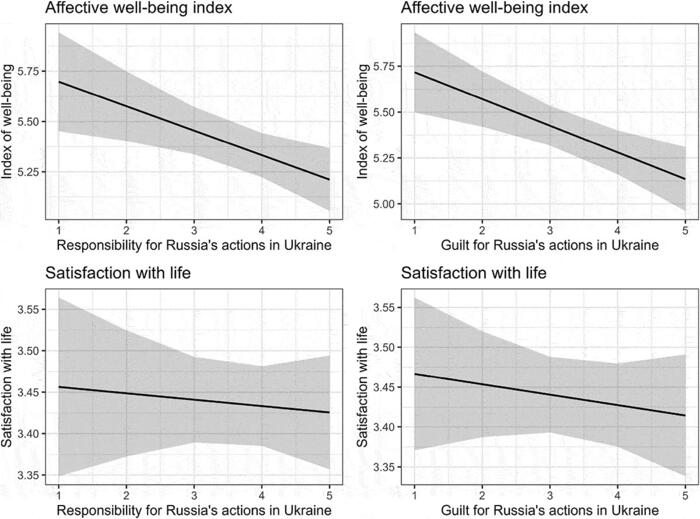
Figure 4. Effect of feelings of collective guilt and responsibility on subjective well-being. The index of affective well-being represents an affective component of subjective well-being, while satisfaction with one’s life represents the cognitive component. Variables are presented in their original scales without standardization. Models with original scales are presented in online appendix D.
These distressing findings have implications for the priorities of host country governments. For one, even economically successful migrants still need legal protections against discrimination and physical insecurity in order to thrive. Second, because fear is itself sufficient to undermine well-being, host countries must (a) take measures to deter transnational repression and (b) make migrants aware that these measures are in place, so as to decrease their fears.
*Brief prepared by Adam Fefer.