
Why Joint Ventures So Often Fail in China
Why Joint Ventures So Often Fail in China
Former Silicon Valley Bank CEO Kenneth Wilcox draws on his own experience launching SVB in China to illustrate how Western companies repeatedly fail in China because they rely on mental models built for home — assumptions about business, government, and rule of law that simply don't apply in the Chinese market.
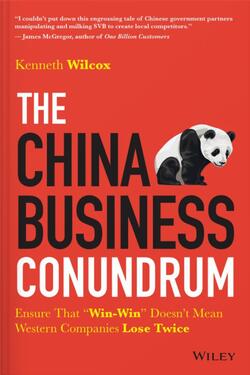
Headlines about foreign companies establishing a foothold in China only to fail years later no longer surprise anyone. But why does this keep happening? Kenneth Wilcox, former CEO of Silicon Valley Bank (SVB) from 2001 to 2010 and author of The China Business Conundrum: Ensure that Win-Win Doesn't Mean Western Companies Lose Twice, argues that the answer comes down to mental models and preparation.
In a recent lecture hosted by the Stanford Center on China's Economy and Institutions, Wilcox explained that we all develop mental models — internal frameworks that help us interpret and navigate the world around us. We carry these models with us wherever we go, applying them instinctively to new situations and environments. The trouble, Wilcox argues, is that a mental model only holds up if the new environment resembles the one it was built for. And American mental models, more often than not, simply don't hold up in China.

Wilcox knows this firsthand. After a decade leading SVB, he and his wife moved to China in 2011 to open a Chinese branch of the bank. Things started smoothly enough — he secured a partnership with Shanghai Pudong Development Bank and obtained the necessary license — but it quickly became clear that the rules he'd spent his career following no longer applied. The license, for instance, permitted him to open the bank but barred him from conducting any business in renminbi, China's national currency, for the first three years. For a bank, this created an obvious problem: how do you pay staff, let alone operate, without access to local currency? The government's solution was a subsidy to cover operating costs during that period, along with an invitation to meet regularly with other banks and business leaders to share SVB's model and approach. After many such meetings, Wilcox's Chinese partners told him they had been so impressed with what they'd learned that they planned to open their own bank modeled on SVB's approach.
This, Wilcox explained, is a pattern that plays out with striking regularity in China. Foreign companies are lured in with the promise of a vast new market and eager local partners. They are then entangled in regulations and bureaucracy, kept afloat with subsidies while they wait for permission to operate more freely — all while their technology and intellectual property are quietly absorbed. Eventually, the foreign company is left with little choice but to close up and leave. Some companies see it happening but look the other way. Others don't recognize it until it's too late. Many never fully understand why they failed at all.
Wilcox traced all of this back to the limitations of mental models. American businesses tend to arrive in China assuming the environment will function more or less like home: keep your head down, stay out of politics, focus on the business, and you'll be fine. But that assumption doesn't hold in China, where the government and the Communist Party exert control over virtually every aspect of commercial life. The most powerful players routinely hold simultaneous roles — party member, bank executive, government official — all at once. It is precisely these unexamined assumptions, Wilcox concluded, that set so many Western ventures up to fail before they've even begun.


