
Pioneering Telemedicine Solutions to Save Sight of Blind Babies in Sub-Saharan Africa
Pioneering Telemedicine Solutions to Save Sight of Blind Babies in Sub-Saharan Africa
Stanford ophthalmology faculty, residents, and medical students are working to provide low-cost screening and treatment for blind babies across sub-Saharan Africa. Among those leading the way is SHP Rosenkranz Prize Winner Arthur Brant.

At a neonatal intensive care unit in Kumasi, Ghana, Stanford medical student Sarthak Shah had difficult news to share with a young mother and the tiny infant swaddled on her back, brown eyes framed by a white cap and bow.
The premature baby, now a few weeks old, weighed barely two pounds at birth and was at risk for an eye disease that can cause permanent blindness if not promptly treated. The mother lived a challenging four-hour bus ride away and was reluctant to return for screenings due to travel costs.
Shah urged the mother to return and offered to reimburse her bus fare. She agreed, and Munira, a locally trained community health worker, took images of the baby’s retinas, which were sent via telemedicine to both a local ophthalmologist and a Stanford vitreoretinal surgeon who devoted his career to this particular disease. They confirmed that the infant’s disease had worsened and that she needed immediate treatment to avert blindness.
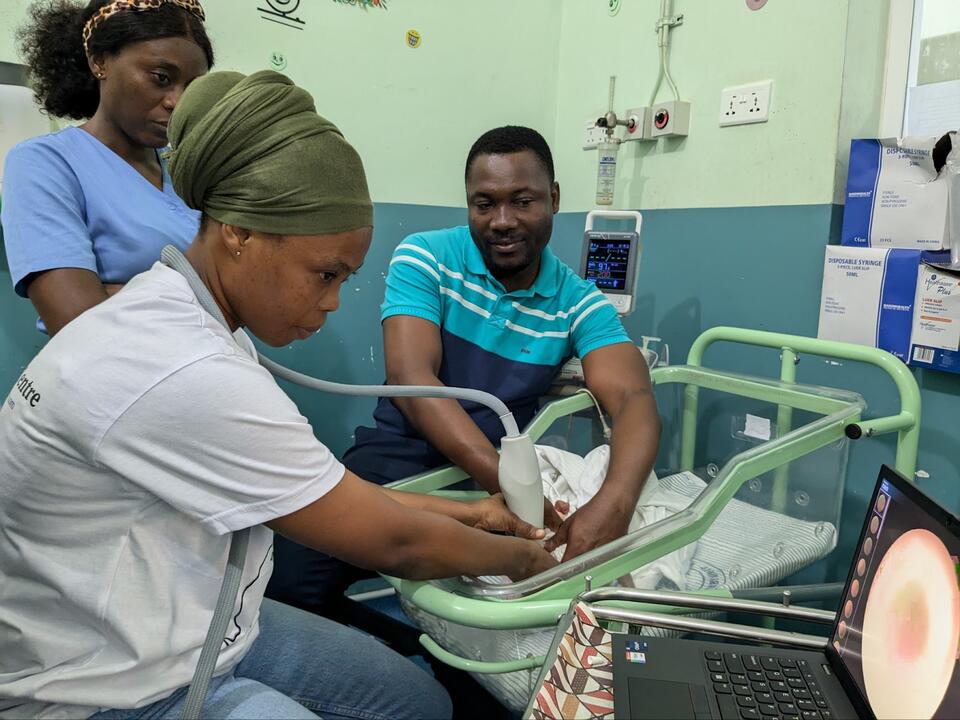
“It was a pretty big shock for this young mother, who was just 17,” Shah recalled. Thankfully, they were able to provide the one-time injection of the medicine required to cure the disease and prevent blindness the same day. The baby soon returned home with her lifelong vision guaranteed.
Just a few years ago, such screening and treatment was unavailable to most babies in Ghana. Outside of one hospital in the capital, Accra, the remaining hospitals in Ghana lacked the necessary eye surgeons and screening equipment.
Now, a growing partnership between Akwasi Ahmed, MD, a pioneering vitreoretinal surgeon in Ghana, and Stanford ophthalmology faculty, residents, and medical students is providing low-cost screening and treatment to babies across the region.
“Our goal is to ensure that no baby goes blind from a condition that is entirely preventable,” said Ahmed.
A Growing Threat of Blindness
Every year, tens of thousands of premature infants in low-resource communities suffer irreversible blindness from retinopathy of prematurity, a condition where irregular blood vessel growth in the developing retina can lead to detachment if untreated. The number of babies at risk is rapidly increasing in Sub-Saharan Africa, where improved care has led to more premature infants surviving. Thus, the need for preventive action is urgent.
A simple one-time injection of a medicine called Intravitreal Bevacizumab can cure the problem. However, this requires regular expert screening over several weeks to catch the condition and intervene quickly. The partnership in Ghana is overcoming these challenges through innovative telemedicine and trained community health workers.
“If you’re blind your whole life from a disease that costs a hundred bucks and two minutes of a surgeon’s time to treat, that’s painful,” said Arthur Brant, MD, an ophthalmologist and project leader. “It’s inexcusable that this is the status quo, and we’re doing our best to move things forward.”
A Visionary Team Across Two Continents
The story began in 2006 when Geoff Tabin, MD, Fairweather Professor of Ophthalmology at the Byers Eye Institute at Stanford and a global leader in combating blindness, aimed to build local capacity for vision care in Ghana. He sought to adapt a successful model from Nepal through the Cure Blindness Project. At that time, there were no ophthalmology training programs and only six ophthalmologists in Ghana, a country of 20 million.
In 2012, Tabin and partners launched Ghana’s first eye surgery residency program, with Ahmed as one of the first participants. Initially hesitant to pursue ophthalmology due to the field’s limited resources and expertise, Ahmed was encouraged by mentors to help meet the immense need. Ahmed traveled to Nepal and India for training before returning as the first vitreoretinal surgeon in Ghana’s Ashanti region, where he now leads efforts to expand ophthalmic training and access to retinal care.
Meanwhile, Brant, then a Stanford medical student, became involved with Tabin’s efforts to provide cataract surgeries in Ghana. He and Ahmed connected over a shared interest in retinal care, recognizing that retinal diseases were a leading but under-treated cause of preventable blindness. As he progressed in his training, Brant received Stanford Health Policy's Rosenkranz Prize in 2023 to address sickle cell retinopathy through cost-effective screenings and treatments.
Brant’s interests eventually shifted to retinopathy of prematurity through discussions with Ahmed, local neonatologist Naana A. Wireko Brobby, and Jessica Sedhom, MD, who was a medical student at the time and is now a Stanford ophthalmology resident. Together, they performed a study in Kumasi to understand the need for retinopathy of prematurity screenings
“The question became how to do this sustainably,” Brant said. “That’s where Dr. Moshfeghi came in.”
Darius Moshfeghi, MD, chief of the retina division and professor at Stanford’s Byers Eye Institute, helped pioneer the field of using telemedicine to diagnose retinopathy of prematurity in children. He has dedicated his career to using telemedicine to prevent blindness and runs the largest telemedicine network in the US for retinopathy of prematurity. With Moshfeghi’s expertise, images (with personal information removed) could be taken in Ghana and sent to Stanford for expert consultation and mentorship to local physicians, who also reviewed the images.
“If you screen babies in a timely fashion, there should be no infant that goes blind from this disease — that’s our premise,” said Moshfeghi. “You look at the babies for 10 weeks, and then they see forever. That’s a win.”
Adapting Cutting-Edge Technology to Local Needs
With Moshfeghi on board, two hurdles remained: acquiring the $30,000 camera for screening and finding someone to take the pictures. Brant, also a software engineer, gathered donations to purchase the camera and developed a custom telemedicine platform. The team decided to hire and train community health workers to perform the time-consuming photography, rather than relying on physicians and nurses.
With the equipment and workforce secured, Stanford Medical Student Sarthak Shah in August 2024 began a year-long research fellowship to establish the telemedicine screening program in Kumasi. Within weeks, Ahmed, Shah and a team of two community health workers, Munira and Mary, had treated their first patient, the tiny baby in the white hat.
The Value of a Lifetime of Sight
On the first day of screening, a devastating experience underscored the team’s commitment to ensuring no babies fall through the cracks. One of the first at-risk babies they saw was past the ideal screening age by the time the clinic opened.
“The white glow we saw when the light shone on the baby’s eyes revealed that both retinas had detached,” recalls Shah, who feels a personal connection to the condition because his uncle was blinded by retinopathy of prematurity. “It was heartbreaking to tell the parents what to expect for the rest of their baby’s life.”
Since then, no baby who received screening through the program has gone blind. This success results not only from an effective screening program, but also from the passion and dedication of everyone involved, from the devoted community health workers to surgeons.
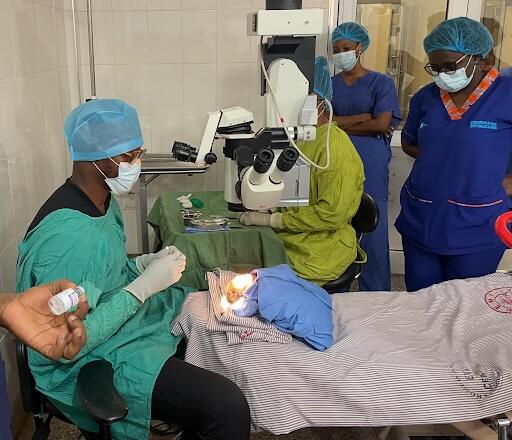
Shah recalls visiting a hospital in the region and noticing a mother carrying a fragile infant to a wellness check. Recognizing an at-risk premature baby, he offered a screening, which found that the baby required immediate treatment to prevent blindness. However, with the hospital’s surgeon away, nobody could provide the urgent treatment.
Shah and the team arranged to have the baby urgently flown to Accra, where another surgeon performed the needed injections. “The flight cost around $150 — a marginal expense considering the value of a lifetime of sight,” he said.
A Growing Movement
To date, the initiative has screened over a thousand babies in Ghana’s Ashanti region and delivered more than 20 preventive treatments.
“If we hadn’t done the screenings, we would not have been able to intervene to save the lifelong vision of these babies,” said Ahmed, who often comes in on weekends to provide the needed injections. “We see it as doing God’s work.”
Now, the team has expanded to include 6 full-time community health workers – Munira, Mary, Edith, Martha, Hamida, and Sarah. Together, they have helped launch two additional screening centers in Accra and Tamale. The team aspires to expand across dozens of cities in Sub-Saharan Africa. With support from additional Stanford faculty, including Scott Lambert, MD, and Prithvi Mruthyunjaya, MD, they founded a nonprofit to fund their ongoing efforts, Zero Blind Babies.
Their efforts contribute to evidence for combining telemedicine with remote ophthalmic expertise. The project has published several research papers, including this one, with local clinicians as lead authors to share their model and findings, garnering interest from leading ophthalmic organizations in Africa.
“I’m excited for what the future holds,” said Ahmed, adding that he looks forward to watching the program grow alongside the number of trained ophthalmologists in the region. “This is not just a job for us; it’s a calling to serve our community.”
This story is courtesy of Jamie Hansen, communications manager at the Stanford Center for Innovation in Global Health.