
Learning Across Disciplines and Cultures: A Japan-Norway Student Exchange
Learning Across Disciplines and Cultures: A Japan-Norway Student Exchange
Eikei University of Hiroshima and Oslo Metropolitan University students share perspectives on local sustainability challenges through human-centered problem solving.

On March 27, 2026, 16 undergraduate students in Japan joined 50 graduate students in Norway for a virtual exchange focused on local sustainability challenges. The session was part of the SPICE Social Entrepreneurship course offered at Eikei University of Hiroshima (Eikei) and co-organized with the Faculty of Technology, Art and Design at the Oslo Metropolitan University (OsloMet).
The exchange served as the culminating activity of a course that SPICE has offered at Eikei since 2022, made possible in large part by the vision of Hiroshima’s former Governor Hidehiko Yuzaki. The course guides students through community engagement, local sustainability challenges, and problem-solving using design thinking methods. This year, students tackled topics including rural transportation, migrant worker conditions, seniors' access to AI, and cybersecurity. What distinguished this iteration was the opportunity for students to test their ideas with an international audience whose academic background differed significantly from their own.
To create that opportunity, SPICE partnered with OsloMet’s master’s program in Applied Computer and Information Technology. Though the two programs differ in size, location, and disciplinary focus – one rooted in liberal arts, the other in STEM – they share a common goal: helping students explore complex social problems through interdisciplinary and cross-cultural collaboration. To prepare for the virtual session, Eikei students created short video presentations introducing the sustainability challenges they had identified in Hiroshima. OsloMet students then reframed those challenges in their own local content and developed technical solutions in response. During the live session, students from both sides met in breakout discussions facilitated by Eikei student assistants, where Oslo teams proposed solutions and Hiroshima teams asked questions and explored implementation.
For Eikei students, the most significant learning emerged from the reflective activities that followed. Students’ responses centered on two pillars the SPICE course had set from the beginning: intercultural competence and interdisciplinary thinking.
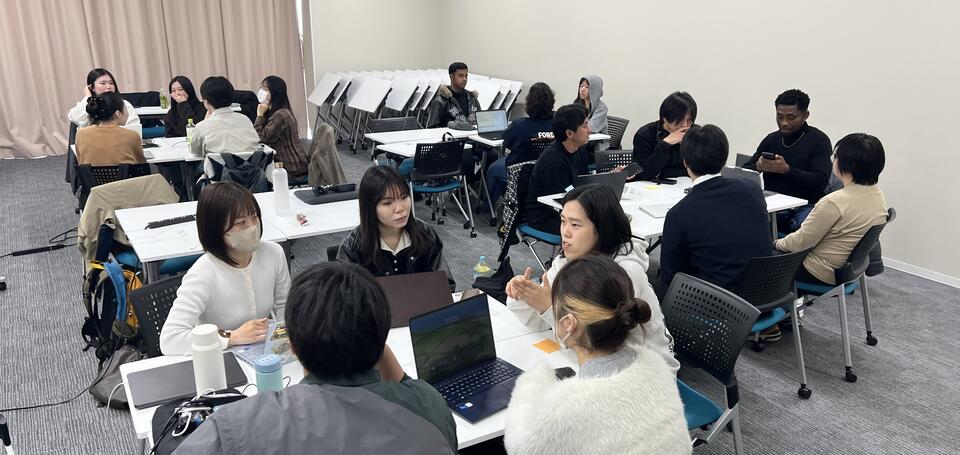 Eikei students reflecting on Japan-Norway student exchange | Photo Credit: SPICE
On the intercultural side, the exchange made clear how deeply local context shapes the way problems are understood and solved. A group working on AI and senior citizens, for instance, found that differing attitudes toward aging in Japan and Norway influenced both how the problem was defined and which solutions seemed viable. One student wrote:
"The most memorable moment was when the very first prototype shown — from Group 9 — was an AI-generated image of a pizza with wheels, with an elderly person smiling next to it. I felt that our perspectives on social welfare and the public good were fundamentally different. Our conception of government's mission is something close to protecting the vulnerable. Their view, by contrast, were rooted in a focus on individual flourishing and self-actualization. It really took me by surprise."
Another student recalled a similarly unexpected moment:
“I received a lot of basic questions about everyday life in Japan — things like 'Isn't it normal for people in Japanese suburbs to ride electric scooters?' or 'How much do elderly people in Japan actually use smartphones?' I had expected questions about complex solutions, but I realized that even things I take for granted carry invisible assumptions and biases. In a cross-cultural setting, you have to align on the basics before you can go deeper."
These moments pushed students to examine their own assumptions and recognize how context shapes both problems and solutions.
The interdisciplinary dimension was equally revealing. Eikei students admired how their Norwegian peers translated broad social concerns into concrete, technically grounded proposals. At the same time, the exchange helped them see the value of their own liberal arts education. One student reflected:
“Since the Oslo students each specialize in one field, it seemed like every group felt compelled to apply that expertise — which meant their solutions often ended up looking similar. We, on the other hand, are trained to approach problems from multiple disciplines and to include not just what’s immediately feasible but also future possibilities. Seeing that difference made so concrete was what left the strongest impression.”
Rather than viewing technical expertise as inherently superior, Eikei students came to see stakeholder engagement and contextual sensitivity as equally essential for addressing complex challenges, and concluded that effective solutions require both. This shift in perspective reflects a central aim of STEAM education: integrating a human-centered perspective into the traditional STEM framework (link to a related article).
This experience reinforced the value of designing courses that connect students across institutions, disciplines, and cultures. The impact, it turns out, extended beyond the participants themselves. One of the Eikei student assistants who helped facilitate the session also reflected on what the experience meant to her (link). Many Eikei students expressed a desire for more sustained collaboration with their Norwegian peers, suggesting that future iterations of such a course could benefit from extending the exchange beyond a single session. More time and more exchanges would create greater space for mutual understanding and deeper engagement with complex "wicked" social problems.
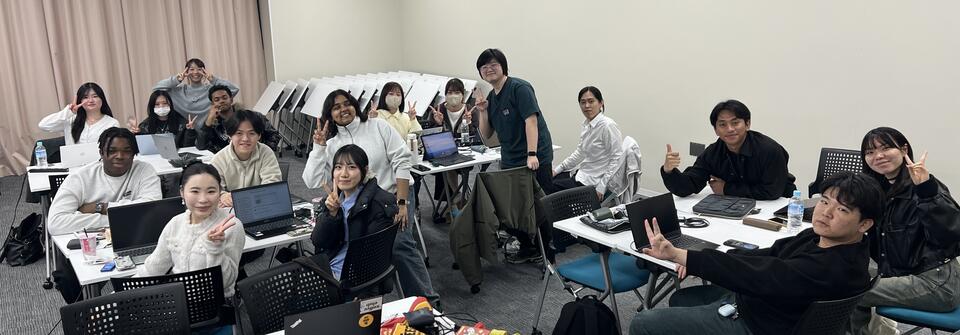 Eikei students in SPICE Social Entrepreneurship course | Photo Credit: SPICE
Acknowledgement: I am deeply grateful to Professor Tulpesh Patel at OsloMet for making this partnership both possible and genuinely rewarding. Since we began working together in August 2025, it has been a true collaboration, the one built on regular conversation, mutual trust, and a shared belief in the value of human-centered, context-sensitive learning, an approach that lies at the heart of STEAM education. Working with Professor Patel has been a personal reminder of why cross-cultural and interdisciplinary collaboration matters.
SPICE's course on Social Entrepreneurship with Eikei University of Hiroshima is one of SPICE’s local student programs in Japan.
To stay informed of SPICE news, join our email list and follow us on Facebook, X, and Instagram.


