
Learning That 38% of African Americans Have Irish Ancestry Reduced Racial Animus
Learning That 38% of African Americans Have Irish Ancestry Reduced Racial Animus
CDDRL Research-in-Brief [4-minute read]

Introduction and Contribution
The significant amount of democratic backsliding currently underway in the United States is in no small part fueled by racial animus. These sentiments underlie indiscriminate deportations as well as the cutting of federal funding to institutions that make use of DEI programs or that are suspected of “wokeness.” More generally, racial resentment is known to intensify political polarization, which itself fuels backsliding. In other words, supporters of the Trump administration may be more willing to accept anti-democratic transgressions because their opponents have been racialized, criminalized, and portrayed as existential threats rather than legitimate opponents.
It stands to reason that reducing racial animus can help reverse the US’s backsliding. How might this be accomplished? In “Close Race,” Jasmine English presents findings from a survey experiment in which white Irish Americans were randomly given information about the proportion of African Americans with Irish ancestry. This number (38%) is much higher than is often assumed. Among recipients of this information, those who identified more strongly with both their Irish American ancestry and the Republican Party were more likely to exhibit decreased racial animus. Open-ended survey questions reveal that just under a third of respondents inferred from the information about African Americans’ Irish ancestry that racial categories are not so mutually exclusive and that differences between racial groups are not so large.
English’s findings are especially pertinent as multiracial Americans have grown at a faster rate (about 25% in the last decade) than any monoracial group in the US. Around one in ten Americans (over 33 million) identify as multiracial. Social scientists have notably added to our knowledge about the political attitudes of multiracials, the choices they make in identifying with this or that racial group, and the ways that voters evaluate multiracial politicians.
Less is known, however, about how the growth in multiracials has affected the attitudes of monoracials. As English discusses, this trend could provoke opposite reactions: On the one hand, monoracials might perceive multiracial growth as a threat to their identity, status, or privileges, leading them to double down on racial prejudice. On the other hand, a greater awareness of shared ancestry could challenge monoracials’ assumptions that racial groups are mutually exclusive, leading to reduced racial animus.
The experiment suggests that merely learning a new fact about ancestry can meaningfully alter racial attitudes. In addition, the experiment utilizes a contrasting approach to “perspective-taking” methods, whereby individuals are encouraged to imagine the experiences of distinct racial outgroups. Yet it may be preferable to challenge the basis or continuity of racial categories rather than encourage people to take these as given. Finally, by studying Irish Americans as a subgroup of white Americans, English shows how disaggregating racial categories can undercut simplistic binary framings. In other words, white Americans who identify with their various ethnic groups may be less inclined to perceive an existential threat from non-whites.
Learning about Shared Ancestry Through a Survey Experiment
English focuses on Irish Americans because they are the US’s third largest white ethnic group, and on African Americans because the black-white divide has been most consequential in American history. If white prejudice toward African Americans can be reduced, then it should be possible (and perhaps simpler) for other racial minorities such as Latinos or Asian Americans.
Over 2,500 white Irish Americans were surveyed in late 2024. English measured the strength of their Irish American identity using three components: (1) linked fate, or the perception that one’s social standing or life chances are connected with the reputation or treatment of other Irish Americans, (2) the importance of one’s Irish American identity, and (3) the closeness that one feels, in terms of values and ideas, to other Irish Americans. Then, racial attitudes were measured using the canonical racial resentment scale as well as various questions about racial prejudice. These assess respondents’ beliefs about the persistence of systemic racism, African Americans’ purported special treatment, and the extent to which African Americans differ from white Americans in terms of trustworthiness, propensity to violence, work ethic, and intelligence. English shows that respondents with stronger Irish American identities also exhibited higher levels of racial animus.
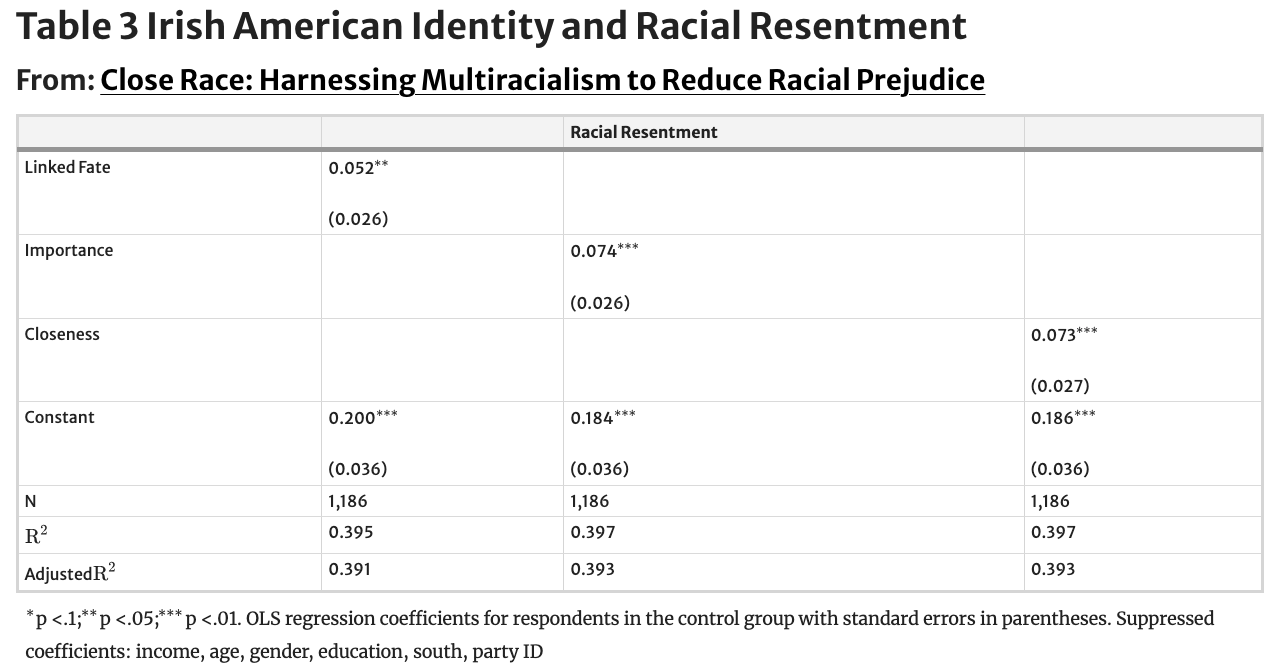
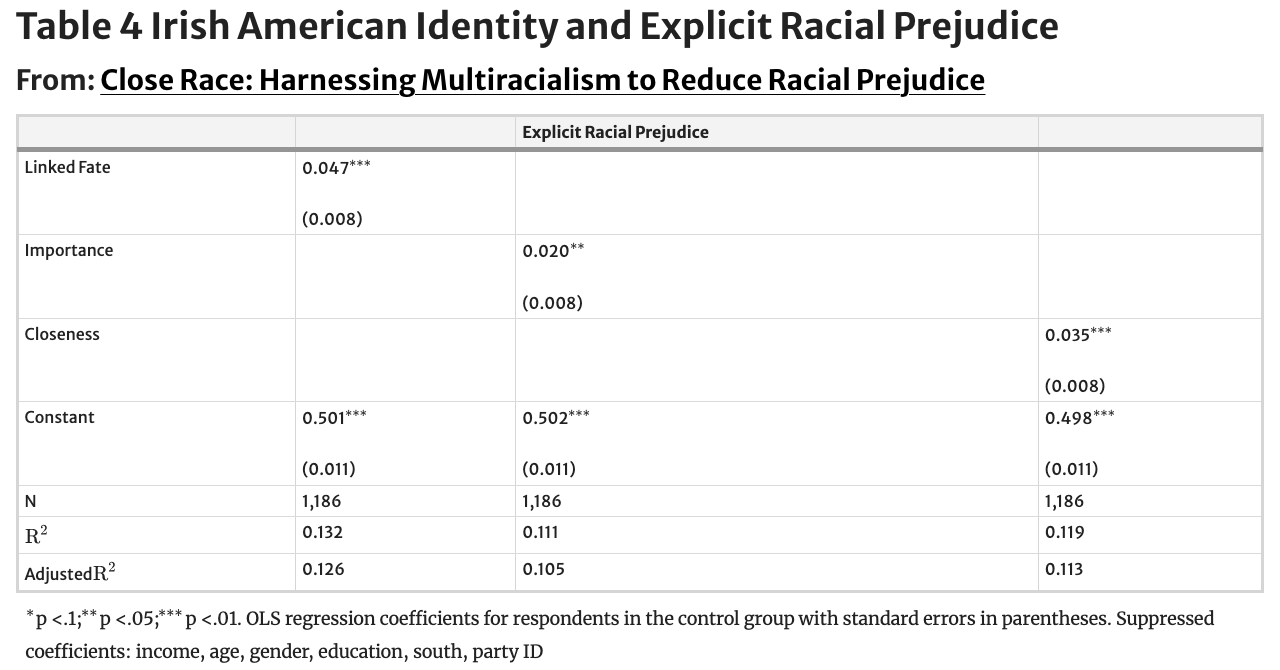
The survey proceeded as follows: First, all respondents were asked to estimate the proportion of African Americans with Irish ancestry. Second, the randomly assigned treatment group received the information that “38% is the correct answer,” while the control group moved on to the next portion. Third, all respondents answered questions about racial resentment and prejudice.
English’s results show that the treatment did not make a statistically significant difference for the full sample, but instead for those with a strong sense of Irish American “linked fate.” Reductions in racial animus were especially concentrated among Republicans with high Irish American identification, which likely stems from the fact that Republicans exhibit higher levels of racial resentment than Democrats or independents.
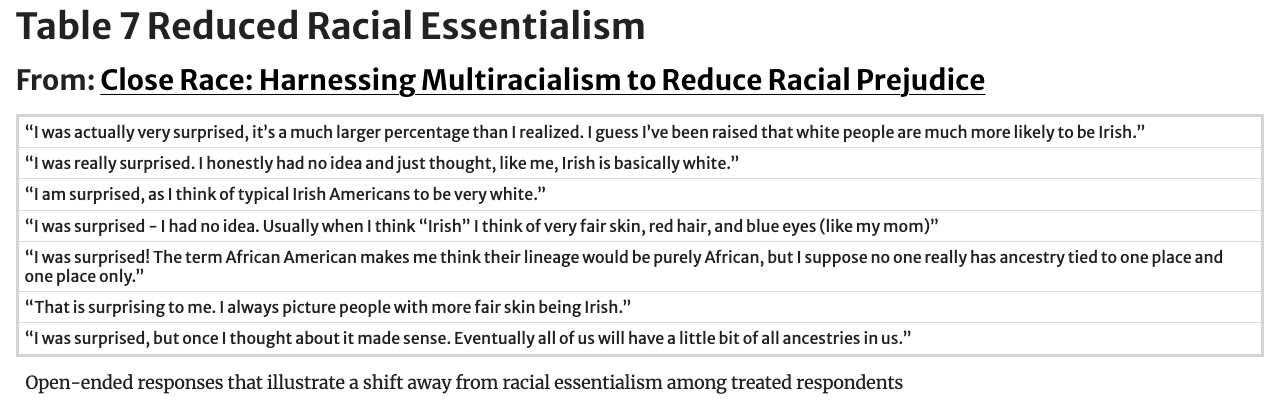
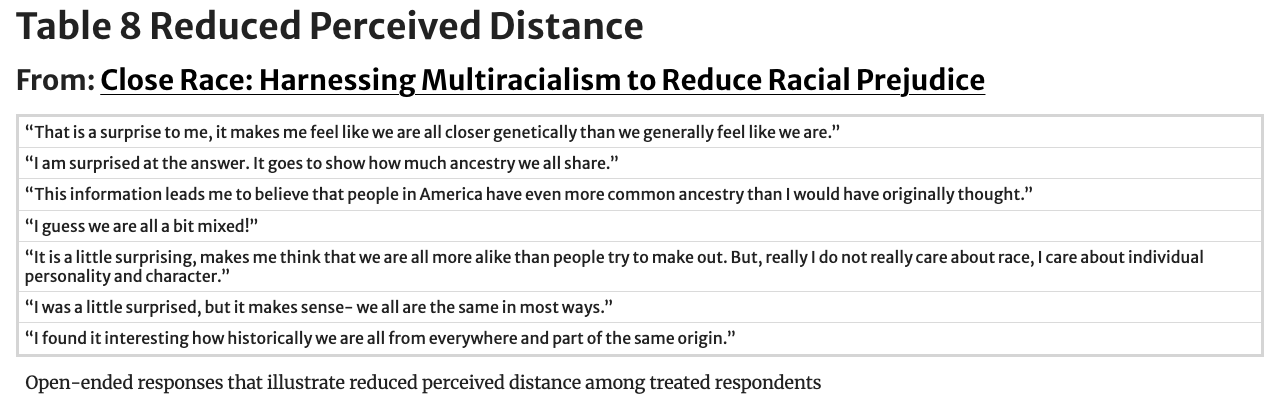
Finally, respondents within the treatment group were asked to describe their reactions to learning about the proportion of African Americans with Irish ancestry. English provides select responses to these open-ended questions, which illustrate how much of a difference the new information made. For example, “I honestly had no idea and just thought, like me, Irish is basically white,” “It goes to show how much ancestry we all share,” and “[it] makes me think that we are all more alike than people try to make out.” In other words, the informational treatment led respondents to view racial groups as less mutually exclusive and the distance between racial groups as smaller. How might these effects generalize beyond Irish Americans?
*Brief prepared by Adam Fefer.