
Examining US Physician Incomes by International Comparison
Examining US Physician Incomes by International Comparison
SHP's Maria Polyakova and Victoria Udalova compare physician income in the United States, Canada, Sweden and the Netherlands. U.S. doctors earn significantly more than their foreign counterparts—but that's largely because Americans across the board earn more.

Physicians are among the most highly trained and highest paid professionals in wealthy nations. In the United States, the high incomes of physicians are often cited as a key contributor to the nation’s high and rising costs of health care.
To support this argument, proponents often point to the fact that U.S. physicians earn more than their counterparts in other wealthy nations.
To examine the debate closer, Stanford Health Policy’s Maria Polyakova, PhD, and colleagues set out to measure how much doctors earn and, crucially, where their incomes fall within the overall income rankings of four wealthy countries: the United States, Canada, Sweden, and the Netherlands.
Their findings were recently released as a National Bureau of Economic Research (NBER) preprint and are forthcoming in AEA Papers and Proceedings later this year.
“In this paper we wanted to examine whether the comparison of average physician incomes across different countries may lead us to misguided arguments,” said Polyakova, an associate professor of health policy and a senior fellow at the Stanford Institute for Economic Policy Research (SIEPR.) “Such direct comparisons of physician earnings don’t take into account the large differences in general income levels across different countries.”
The researchers used administrative tax records linked to occupational records to study physician pay in the four countries. They identified doctors by matching their tax records with job codes or healthcare provider lists, allowing them to look at almost all doctors in each country.
For the United States, the analysis closely followed the researcher’s 2023 study that showed that physicians’ personal earnings only account for 8.6% of national health-care spending in the United states. The new research looks at how physician incomes fit into overall income levels in the country, instead of just focusing on how much money they make individually.
Victoria Udalova, PhD, an affiliated researcher at Stanford Health Policy and principal economist and director of the Enhancing Health Data (EHealth) Program at the U.S. Census Bureau, is a co-author of the study.
U.S. Doctors Highest Earners?
As expected, the researchers found that in the United States, physicians earn the most on average. The income differences were especially pronounced among the top earners. In the United States, the top 1% of doctors make about $1.2 million per household, and $1 million individually. In comparison, top doctors in Canada earn around $500,000, while those in Sweden and the Netherlands make less than $400,000. Doctors in the 98th percentile in the United States earn over $500,000, while their counterparts in the other countries earn about $200,000.
But many people in the United States earn a lot more. Despite the large differences in income level of physicians, drawing conclusions from these numbers can be misleading, the authors argue. The U.S. income distribution looks very different than that in other countries and generally provides high returns to many high-skilled occupations—not only physicians.
To understand physician income in the larger picture of national earnings, the researchers examined where doctor households fit within the overall income levels of different countries. They found that doctors are mostly in the top 10% of earners in every country they studied. In the United States, more than 84% of physicians are in the top decile, with 26% in the top percentile alone. In the other three countries, roughly 60% of physicians are in the top decile.
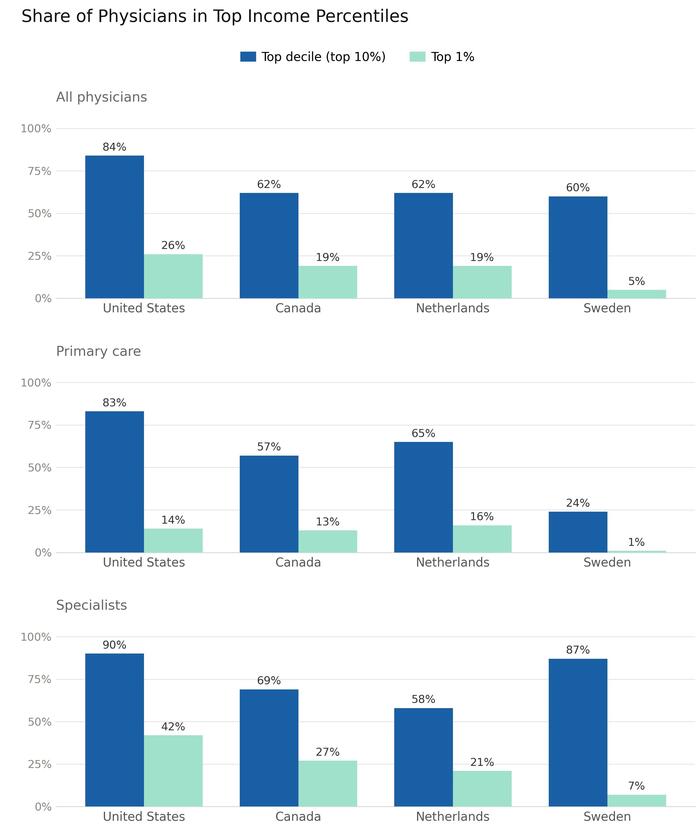
“Perhaps the most fundamental finding from our cross-country comparison is that the overall income distribution within each country plays a major role in shaping physician income,” Polyakova said. “U.S. physicians earn substantially more than their counterparts in Canada, the Netherlands, and Sweden, but much of this difference can be attributed to higher incomes at given percentiles of the overall U.S. income distribution.”
The researchers estimated that if the average income of doctors in the United States dropped to the same level as in Sweden, where the average income is the lowest, health-care spending in the United States would decrease by 6%. This would amount to $291 billion, or 1% of the country’s total economic output, shifting from 17.6% of GDP to 16.6%.
“In other words, this change would have a modest effect on U.S. health-care spending, but would represent a $342,800, or 75%, reduction in average U.S. physician incomes, which would likely have a substantial impact on students’ choice of whether to become physicians,” they authors wrote.
“In all countries we analyzed, physicians tend to be the top students in the country. In the U.S., such students likely have many other attractive opportunities to land in the top brackets of the national income distribution,” Polyakova said. “Lowering expected incomes of physicians may lower health-care spending but it will also likely change who decides to pursue medicine. These observations are an important caveat for any efforts to reduce U.S. health-care spending by lowering physician compensation.”


