
Hanming Fang | Measuring Judicial Biases with Artificial Intelligence: Evidence from Chinese IP Litigations
Hanming Fang | Measuring Judicial Biases with Artificial Intelligence: Evidence from Chinese IP Litigations
Tuesday, April 14, 202612:00 PM - 1:30 PM (Pacific)
Goldman Room E409, Encina Hall
Skyline Scholars Series
Tuesday, April 14, 2026 | 12:00 pm -1:30 pm Pacific Time
Goldman Room E409, Encina Hall, 616 Jane Stanford Way
Registration for this seminar is now closed.
Measuring Judicial Biases with Artificial Intelligence: Evidence from Chinese IP Litigations
How does judicial fairness in intellectual property (IP) litigations shape the incentives to innovate? This talk examines local bias in IP litigation and its consequences for firm-level innovation in China.
Using a dataset from China Judgements Online on Chinese IP court decisions from 2014–2020, a striking puzzle emerges: despite widespread concerns about local protectionism, non-local plaintiffs frequently win at higher rates than local ones. Two competing forces explain this — a "local protectionism effect," whereby local fiscal incentives bias courts toward local firms, and a "picket fence effect," whereby litigants anticipate bias and self-select out of bringing cases, quietly distorting the pool of disputes that reach the courtroom.
To cut through this identification challenge, researchers train an LLM–based "AI court'' on cases in which both plaintiff and defendant are non-local for which the incentives of local courts to bias either side are absent, generating counterfactual fair win-rates for all other disputes. Comparing observed and predicted win-rates reveals significant judicial bias. A 2019 reform centralizing appellate jurisdiction over a subset of IP cases, namely the technical cases, directly to the National Supreme Court shows that stronger central supervision substantially improves judicial accuracy and curtails bias — and measurably increases firm innovation.
The findings underscore that impartial courts are not just a procedural ideal, but a concrete driver of economic dynamism.
About the Speaker
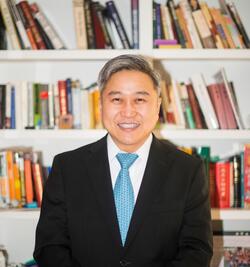
Professor Hanming Fang is an applied microeconomist with broad theoretical and empirical interests focusing on public economics. He is the Norman C. Grosman Professor of Economics at the University of Pennsylvania and a Skyline Scholar (April 2026) at the Stanford Center on China’s Economy and Institutions. His research integrates rigorous modeling with careful data analysis and has focused on the economic analysis of discrimination; insurance markets, particularly life insurance and health insurance; and health care, including Medicare. In his research on discrimination, Professor Fang has designed and implemented tests to examine the role of prejudice in racial disparities in matters involving search rates during highway stops, treatments received in emergency departments, and racial differences in parole releases. In 2008, Professor Fang was awarded the 17th Kenneth Arrow Prize by the International Health Economics Association (iHEA) for his research on the sources of advantageous selection in the Medigap insurance market.
Professor Fang is currently working on issues related to insurance markets, particularly the interaction between the health insurance reform and the labor market. He has served as co-editor for the Journal of Public Economics and International Economic Review, and associate editor in numerous journals, including the American Economic Review.
Professor Fang received his Ph.D. in Economics from the University of Pennsylvania in 2000. Before joining the Penn faculty, he held positions at Yale University and Duke University. He is a research associate at the National Bureau of Economic Research, where he served as the acting director of the Chinese Economy Working Group from 2014 to 2016. He is also a research associate of the Population Studies Center and Population Aging Research Center, and a senior fellow at the Leonard Davis Institute of Health Economics at the University of Pennsylvania.