Dear friends of FSI,
During my 11-year tenure as FSI director, I have always been proud of the work being done across the institute. This year is no exception. As geopolitics have only grown more complex in 2025, our scholars have conducted groundbreaking research, taught and advised hundreds of students, and influenced policy on the most pressing issues of our time.
It has been a sobering year, with February marking the third anniversary of Russia’s full-scale invasion of Ukraine, which continues amid tenuous negotiations for peace. Tensions are ongoing in the Middle East, despite UN Security Council approval of a U.S.-drafted resolution for a ceasefire in the Gaza Strip in November. The rise of autocrats across the globe continues, with regimes in South America emulating Bukele’s brutal model of authoritarianism and a growing number of right-wing opposition parties coalescing in Europe. As the AI race between the U.S. and China escalates, we still must answer the question of how to regulate AI’s impact on our shared sense of safety, security, and democracy.
At FSI, our core mission is to address these global challenges, and I couldn’t be more grateful for the faculty, students, staff, and donors who make it all possible. I am excited to share with you some notable highlights of FSI’s achievements and contributions this year.
Earlier this year, some of our scholars travelled to Paris to participate in the AI Action Summit and share their research on how AI is impacting democracies around the world. At our annual Oksenberg Symposium, I had the privilege of joining other FSI experts in discussing how China, Russia, India, and the United States are reshaping their strategies and relationships. Our scholars were also in Taipei to discuss how Taiwan can develop comprehensive strategies to promote its national interests and modernize its economy.
This fall, we permanently endowed the Jan Koum Israel Studies Program at the Center on Democracy, Development and the Rule of Law (CDDRL), which will deepen understanding of Israel through new classes, collaborative research, and community engagement. In addition, the recently launched Democracy Action Lab at CDDRL will combine rigorous research with practitioner collaborations to help stop democratic backsliding.
Other key events and achievements from 2025, include:
- The Shorenstein Asia-Pacific Research Center (APARC) co-hosted the 2025 Sustainability Dialogue, “Climate Action: Billions of Trees,” which brought policymakers, researchers, and practitioners together in Mongolia.
- The Japan Program at APARC hosted two major events: a symposium examining the shifting Japan-U.S. bilateral cooperation, and a conference that explored the creative ecosystems driving the international success of Japan’s content industries.
- The Stanford Center on China’s Economy and Institutions hosted their second annual China Conference, bringing together leading scholars and policy experts to discuss China's global economic position and current U.S.-China dynamics.
- Alumni and students of the Ford Dorsey Master's in International Policy program came together for networking and a discussion on how current affairs in the United States affect the rest of the world.
- Analysis from David Lobell (Gloria and Richard Kushel Director, Center on Food Security and the Environment) and colleagues determines that agriculture accounts for almost a quarter of global greenhouse gas emissions, which means reducing agricultural emissions could create a powerful, positive GHG feedback loop.
- Michelle Mello (Professor, Stanford Health Policy) addressed the U.S. House Committee on Energy and Commerce regarding the advancement of AI in healthcare.
- Six scholars from the Center on International Security and Cooperation joined global experts and Nobel Laureates at the University of Chicago to confront the escalating risks of nuclear war.
- The Social Media Lab at the Cyber Policy Center has been selected by Australian lawmakers to contribute expertise and guidance for the recently passed Social Media Minimum Age legislation.
I also want to congratulate all the graduates of the Ford Dorsey Master’s in International Policy (MIP) Class of 2025, the CISAC Honors Program, and the Fisher Family Honors Program at CDDRL. I am always inspired by these students, who truly represent the next generation of global leaders.
While reflecting on our many accomplishments together this year makes me incredibly proud, writing this letter is bittersweet.
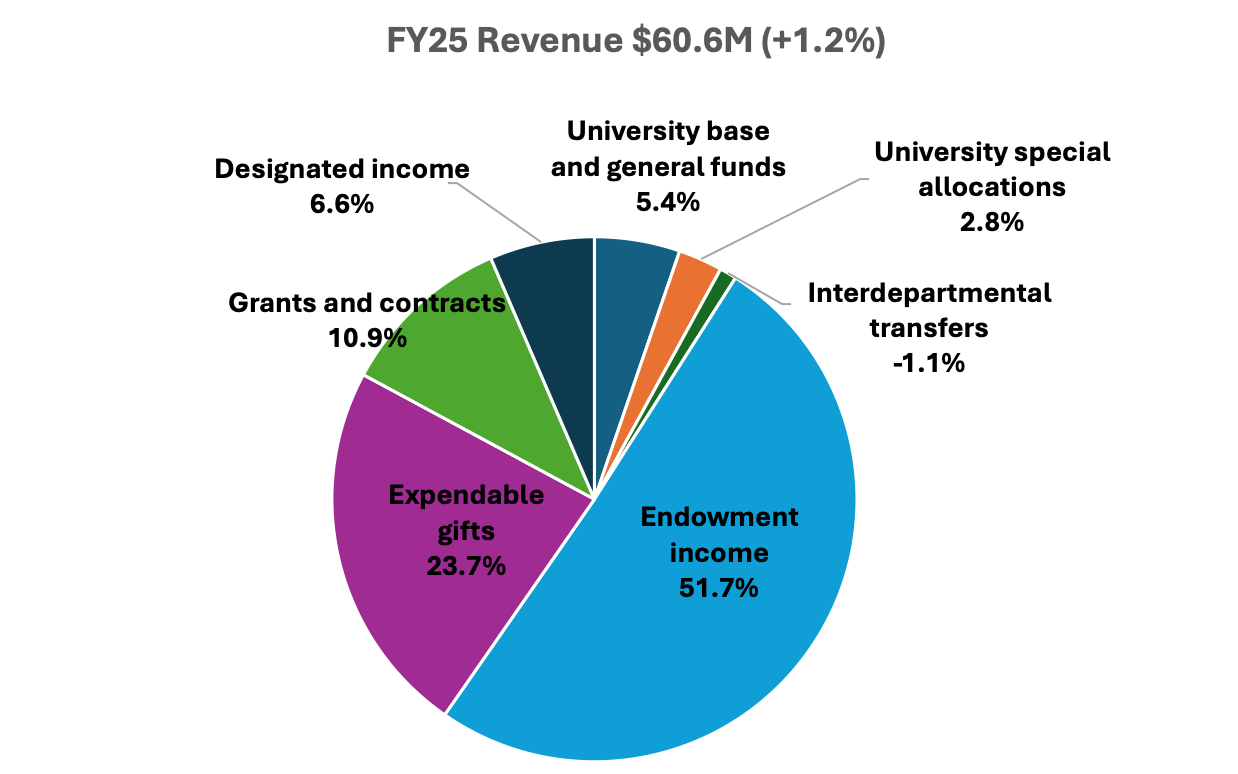
As many of you know, I am stepping down as FSI director at the end of December. It has been an honor to have led this dynamic institute for over a decade. I am immensely proud of our accomplishments over that time. Our footprint at the university has grown in myriad ways, including the addition of three new centers – the Stanford Tech Impact and Policy Center, the Stanford Center on China’s Economy and Institutions, and the Gordian Knot Center for National Security Innovation – the expansion of the Master’s in International Policy (MIP) program, and the appointment of 18 new senior fellows, two center fellows and four senior research scholars, and a host of other appointments including many courtesy appointments for professors around the university. We have also forged many strategic partnerships across campus and around the world, ranging from the Hoover Institution and the Doerr School of Sustainability close to home, to the Brookings Institution, Carnegie Endowment for International Peace, and Kyiv School of Economics farther away. We have also raised endowments for seven senior fellowships and grown FSI’s revenue from $31.1M in AY2015 to $60.6M in AY2025. Our total staff at FSI is now approaching 500. You can see some of our policy impact here. And most importantly, the production of scholarship by FSI senior fellows, including several dozen books and hundreds of articles in top academic and policy journals has exploded over the last decade.
Achieving these benchmarks leaves FSI in a fantastic position as it shifts to new leadership and institutional priorities. Please know I am not leaving Stanford or retiring. Instead, part of my plan is to engage more directly with the people of the United States to help them better understand the importance of democracy and the role they play in ensuring its solvency. In the past several months I have traveled extensively to promote my new book, Autocrats vs. Democrats: China, Russia, America and the New Global Disorder, in places ranging from San Antonio, Texas, to Columbia, South Carolina, to Erie, Pennsylvania. I have been heartened and humbled that every venue has been full, and every talk has been received by a warm and welcoming audience. This has aptly demonstrated that the American people care deeply about America’s place in the world, providing me more inspiration to continue this important work.
I also want to take this opportunity to welcome the new director of FSI, Colin Kahl, who will take the helm in January. Colin is the Steven C. Házy Senior Fellow at FSI, primarily affiliated with CISAC, and a former senior U.S. defense and White House official whose career spans academia and public service roles that have shaped U.S. foreign policy on critical security issues. He has served under both Republican and Democratic administrations, earning the Department of Defense’s highest civilian honors for his leadership and dedication to national security. I am truly thrilled that Colin will be FSI’s next director, as he is both a first-class academic and a former policymaker at the highest levels – the perfect combination for leading FSI.
I have no doubt that in the coming years, FSI will continue to expand its reach, from teaching and adding new areas of inquiry to working with local and federal lawmakers to address the challenges facing the world.
We appreciate your ongoing support and engagement, and wish you all the best in 2026.
Sincerely,
Michael McFaul
Senior Fellow and Director, FSI
Ken Olivier and Angela Nomellini Professor of International Studies,
Department of Political Science
Peter and Helen Bing Senior Fellow, Hoover Institution